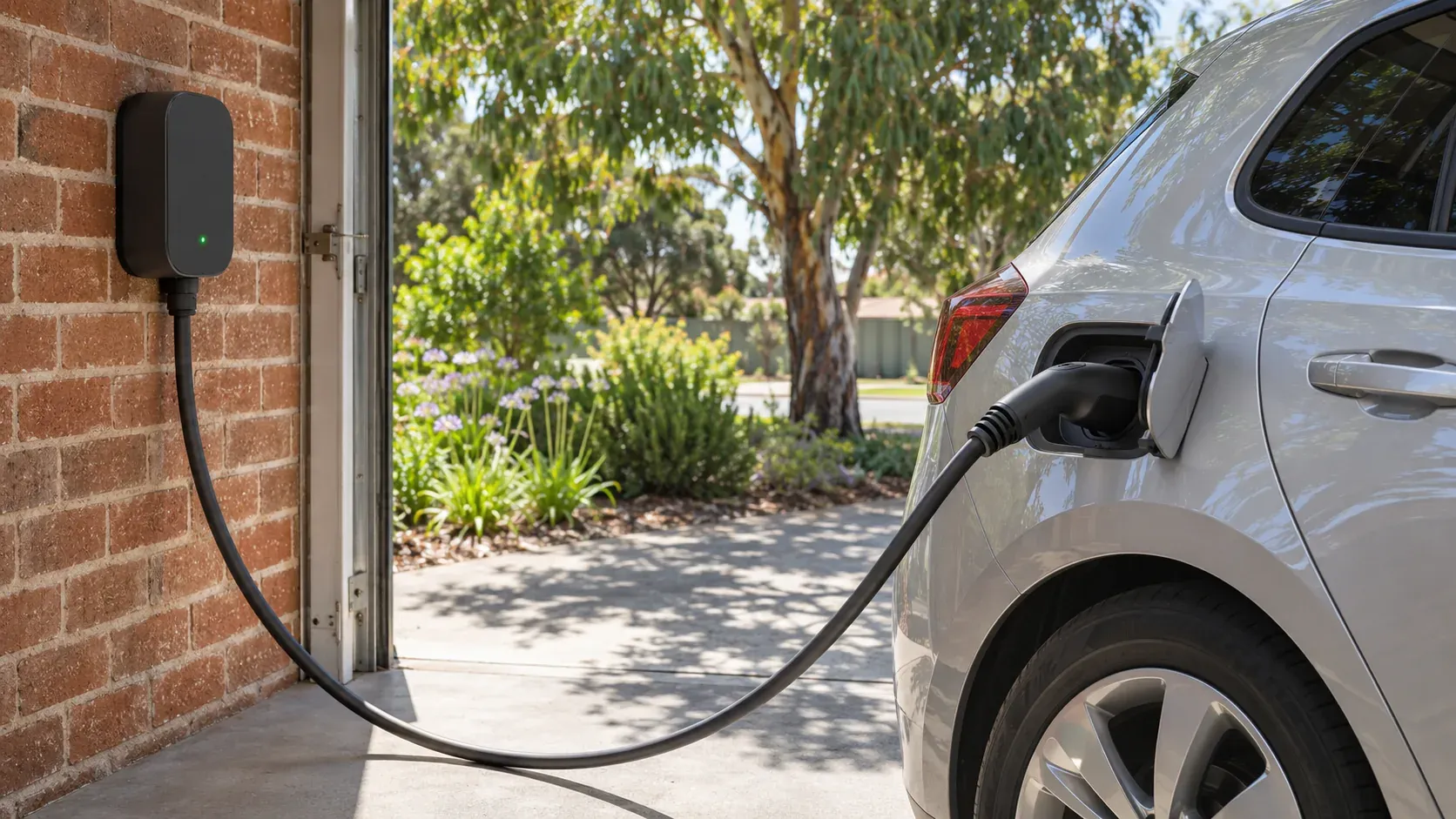
Solar EV charging at home means using rooftop generation to charge your car while sunlight is available. Australian households can use a suitable power-point charger or a dedicated wall unit; a home battery is optional. Compare 3 approaches: daytime scheduling, surplus-following charging and solar-plus-grid charging, rather than assuming every smart charger avoids grid imports.
At a glance
- The Australian Government's EV charging guide describes 2 home charging options: a standard power point and a dedicated charger.
- Government guidance describes dedicated home chargers rated 7–22 kW; that is equipment capability, not a promise of solar-only charging speed.
- Solar Victoria explains that daytime solar can provide regular top-ups without filling the entire car battery in one day.
- A fixed charger must be installed by a licensed electrician; check supply capacity and any switchboard work before accepting a price.
How does solar EV charging work at home?
Your rooftop system supplies electricity through the home's electrical installation, and the connected car uses some of that energy while charging.
In an ordinary home AC charging arrangement, the solar inverter converts panel output into alternating current. The car charges through suitable charging equipment, not through a panel cable plugged directly into the vehicle. RACV's solar-charging explanation describes this inverter pathway and the difference between solar-only and mixed solar-and-grid charging.
The useful quantity is surplus after other household loads, not the array's headline rating. Cooking, cooling and hot water may already be using generation when you connect the car. Compare solar monitoring with household import/export data and the hours the vehicle is actually parked at home.
This guide covers electricity going into the car. Supplying the home or exporting from a vehicle is a separate bidirectional-charging question; do not assume an ordinary solar-aware wall charger provides that capability.
Which charging approach suits your routine?
Choose controls around your departure time and tolerance for grid imports, rather than buying only on maximum charging power.
The government recommends smart charging or energy management that can respond to excess rooftop generation. RACV also distinguishes solar-only, mixed-source and scheduled charging. Names vary between products, so ask the installer to demonstrate the actual behaviour proposed.
| Approach | What you are asking it to do | What to check |
|---|---|---|
| Daytime schedule | Charge during a selected daylight window | A timer alone does not establish that solar covers the load |
| Surplus-following | Adjust charging to available excess solar | Metering, minimum operating level and pause/restart behaviour |
| Solar plus grid | Use solar while allowing grid energy to help meet charging needs | Import settings, tariff timing and departure target |
A solar-only setting may not suit a day when you need to leave with more charge than the sunshine can supply. Conversely, an unrestricted fast setting can purchase electricity even on a sunny afternoon. Ask which settings take priority when the car's own schedule and the charger's schedule disagree.
Bring a simple weekly parking timetable to the quote discussion. A household with a car at home on weekdays has a different opportunity from a commuter who can only plug in overnight or at weekends.
How much solar energy does your driving need?
Estimate the energy needed to replace your driving, then compare it with available surplus during charging hours.
Use your vehicle's measured consumption or applicable manufacturer information, not a universal number of panels. kW measures power; kWh measures energy. Daily kilometres and energy per kilometre help estimate an energy requirement, while charging power determines how quickly that energy can be supplied.
Solar Victoria recommends assessing both driving habits and ordinary household needs. Its guidance also warns that some systems cannot replenish an empty EV battery in one day, even though they can cover regular top-ups. Our household solar sizing guide explains why consumption and timing matter alongside roof space.
Request a seasonal estimate, including shading and the proposed roof layout, instead of treating an annual daily average as a winter guarantee. If your existing array already exports useful daytime energy, investigate using that surplus before assuming that an EV requires replacing the whole solar system.
What does an illustrative Melbourne energy check show?
A daily energy budget can show whether a charging window is plausible, but it does not guarantee a departure charge level.
Consider a hypothetical Melbourne household, not a customer result. Assume 40 km of driving, 18 kWh per 100 km consumed from the car battery, and 90% charging efficiency from the home's supply to stored energy. These are chosen modelling assumptions, not a claim about an average Australian driver or a particular vehicle.
- Driving energy to replace: 40 × 18 ÷ 100 = 7.2 kWh.
- Electricity needed at the charging supply: 7.2 ÷ 0.90 = 8 kWh.
- If the available surplus averages 2 kW for 4 hours, the energy budget is 2 × 4 = 8 kWh.
That looks sufficient on paper only if the car is connected, the equipment can operate over that window and the assumed surplus remains available. Clouds, other loads, charging limits and control behaviour can change the result. Ask for interval-level assessment rather than a daily-total match alone.
For a separate illustrative cost comparison, assume an import rate of 30c/kWh and an export credit of 5c/kWh. Redirecting 8 kWh that would otherwise have been exported, instead of importing 8 kWh at that rate, gives 8 × ($0.30 − $0.05) = $2.00 in energy-charge difference for that session.
Those rates are hypothetical, not a current retailer offer. The calculation excludes equipment costs, fixed charges and other tariff conditions, and is not an annual savings or payback forecast. Compare your own plan's import and export terms using our feed-in tariff comparison guide.
Do you need a home battery or a faster wall charger?
Neither is automatically necessary: first establish when the car is home and how much energy you need to add.
Solar Victoria describes charging from a suitable power point during solar-generating hours, while the federal guide says a power point may meet daily driving needs. Have a licensed electrician assess the outlet, circuit and charging arrangement; do not treat an existing garage socket as proof of suitability. Government guidance recommends connecting directly rather than using extension cords or power boards.
A dedicated charger can offer faster charging and controls, but actual performance must suit the home's supply and the car's charging requirements. Ask for the supported rate for your exact vehicle and proposed installation, not just the largest number on the wall unit.
A stationary battery can make stored daytime energy available later, but Solar Victoria notes that energy used for the car is then unavailable for other household needs. Compare that allocation before adding storage purely to charge overnight. A larger battery does not create extra solar generation or make every charging session solar-powered.
What should you check on your quote?
Ask for one complete solar-and-charging scope that explains electrical work, controls and commissioning.
The government says a dedicated charger may require switchboard or supply-connection upgrades. We have not established a comparable national installed-price range for this guide, so there is no equipment-only price presented as a fully installed offer. Use the same requirements for every quote; our three-quote checklist helps structure that comparison.
- Energy fit: provide driving needs, parking hours, solar output and household interval data where available.
- Equipment fit: record the exact car, charger, connector and supported charging rate.
- Solar controls: identify metering hardware, communications, operating modes and any ongoing fees.
- Electrical scope: itemise circuit work, cable route, switchboard work and any required network process.
- Other loads: ask how charging interacts with existing storage, hot water and supply limits.
- Handover: include settings, demonstration, warranties, support responsibilities and the final price including GST and exclusions.
For apartments, Solar Victoria advises consulting both an EV charging specialist and the owners corporation. Do not assume permission to install a personal charger or use shared electricity is included in an ordinary detached-home quote.
Frequently asked questions
Can I charge my EV directly from solar panels?
You can use rooftop solar to charge an EV, but an ordinary home AC setup still uses the solar inverter, household wiring and suitable charging equipment. It is not a direct panel-to-car cable connection. RACV explains that available solar and charging mode determine whether grid electricity is also used.
What is the best solar EV charger in Australia?
There is no universal winner for every home and vehicle. Compare solar-surplus controls, vehicle compatibility, supply capacity and the charging window you need. The government's guidance recommends assessing driving needs and obtaining licensed electrical advice. A higher advertised power rating alone does not establish the best fit.
Is there a solar powered EV charger?
Yes, charging equipment can use electricity generated by your rooftop solar system. Some smart arrangements can respond to excess generation, while others mainly provide scheduling. The government describes both smart charging and solar use. Ask whether the quoted system measures surplus and when its selected mode permits grid imports.
How many solar panels do I need to charge an EV?
There is no fixed panel count because driving energy, household demand, panel rating, location and charging hours differ. Solar Victoria recommends assessing driving and household needs together. Start with energy needed for regular top-ups, then ask for a site-specific generation estimate rather than sizing from the car's full battery capacity alone.
Compare before you commit
Give each installer the same driving timetable, existing solar details and charging priorities. Your Solar Quotes can help you compare up to three free solar quotes, so you can assess the solar design and ask what EV-charging integration is included rather than compare differently scoped packages.
Sources
- Australian Government: How to charge your electric vehicle, checked 19 November 2026.
- Solar Victoria: Getting your home EV-ready, checked 19 November 2026.
- RACV: How much solar energy do I need to charge my EV?, checked 19 November 2026.