System size and roof fit
Compare what your roof can actually support, how the system is sized, and whether your daytime load justifies the proposal.
Commercial solar guide 2026
A practical guide to comparing commercial solar quotes, rebates, payback, finance, and installer proposals before you commit.
Free guide + 3 trusted commercial solar quotes
Businesses helped
3,600+
Installer network
966
Quote process
3 proposals
Guide focus
Solar ROI
What this guide helps you compare
Commercial solar is rarely just a panel price. The useful comparison is how each installer explains your site, usage profile, certificates, finance options, and expected payback.
Compare what your roof can actually support, how the system is sized, and whether your daytime load justifies the proposal.
Understand whether upfront STCs, certificates earned over time, tax treatment, or state programs are being modelled clearly in each installer quote.
Check how tariffs, solar self-consumption, exports, and finance assumptions affect the projected commercial return.
Use multiple proposals to compare equipment, warranties, monitoring, maintenance, and commercial installation experience.
System types
Warehouses, retail sites, farms, schools, medical centres, and offices can all have different load profiles. The guide explains common system types before you compare installer recommendations.
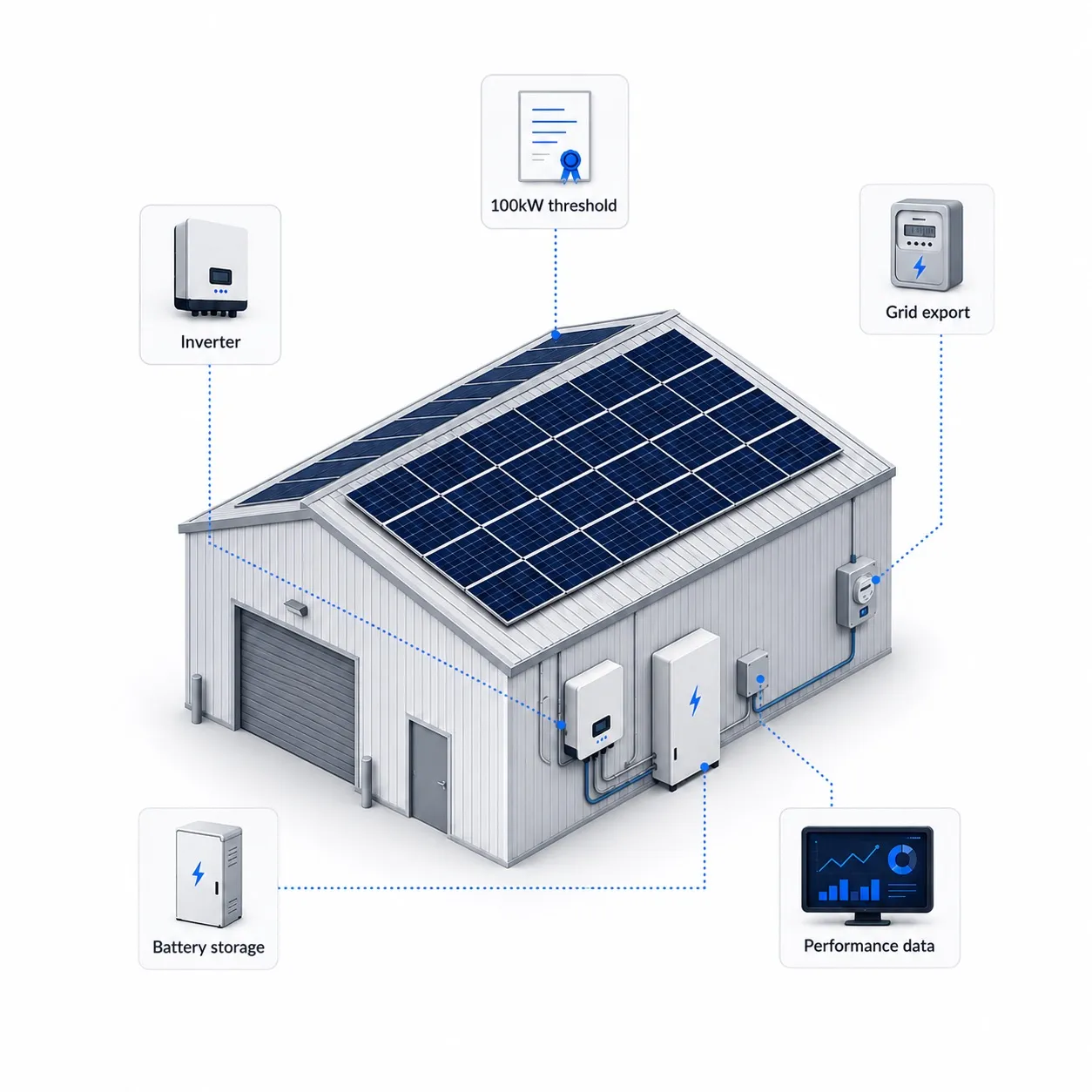
The common commercial setup for businesses wanting to offset daytime electricity use and export excess generation.
Useful when backup power, peak demand reduction, or stored solar energy can improve the commercial case.
A specialist option for remote sites where grid connection is unavailable, unreliable, or commercially impractical.
A practical option for larger car parks, shopping centres, airports, and commercial sites with limited roof space.
Cost and payback
The guide breaks down typical commercial system ranges and why roof access, engineering, network approval, equipment quality, tariffs, and finance can change the final proposal.
Under 30kW
Often suited to offices, shops, cafes, small warehouses, and owner-operated commercial sites.
30-100kW
A common range for larger usage sites where roof space, daytime consumption, and upfront STCs can align well.
100kW+
Eligible systems up to 1MW installed from 1 October 2026 can now claim upfront STCs, but still need detailed modelling around engineering, metering, network approval, and maintenance.
Proposal quality
A strong commercial proposal should make the trade-offs visible, not hide the most important numbers in the fine print.
Compare proposals
Start with your business postcode and we will help match your request with trusted commercial solar installers.
We are the trusted experts in commercial solar.
We have helped 3,600+ businesses reduce their overheads, and environmental impact since 2014.
Your Solar Quotes have developed bespoke software to walk you through the process of solar comparison, ensuring that you are informed at every point of your solar journey.
Our in-house experts will create a business case, and use this to recommend the best installers from our vast network of 966 of Australia's highest regarded solar companies.
We are proud to make the process of transitioning your business to clean energy as smooth as silk.
Our mission at Your Solar Quotes is to reduce Australia’s dependence on fossil fuels and help people harness clean, renewable energy from the sun.
We have done the due diligence and worked hard to find the solar companies who will go above and beyond for our customers. Our business values transparency, fairness, customer service, and accountability, and we look for these same values in the solar companies that we recommend.
We believe the search for solar should be an educational and hassle-free experience. Using our customer feedback system, we champion the solar companies who are highly effective at what they do - ensuring that your search for solar, and our collective future is in safe hands.
Whether your goal is to reduce your business' operating expenses or meet sustainability targets, investing in commercial solar is a very sound investment. We have outlined the key benefits of installing solar on your business below:
Commercial solar systems come in various configurations, tailored to different business needs, location, and energy requirements. Here are the common system types:
Grid-Connected Solar Systems:
Hybrid Solar Systems:
Off-Grid Solar Systems:
Solar Carports
The huge energy cost savings from installing solar are bolstered by significant rebates, and tax incentives tailored to businesses. Outlined below are key commercial solar rebates available in Australia, aimed at expediting the return on investment for businesses:
The federal Renewable Energy Target supports commercial solar through two schemes:
What changed on 1 October 2026: the SRES now extends to eligible mid-scale solar systems from 100kW to 1MW installed from 1 October 2026. Previously, systems above 100kW fell outside the small-scale scheme. How the three size bands now compare:
Upfront STCs or certificates over time? Owners of 100kW to 1MW systems can alternatively register under the Renewable Electricity Guarantee of Origin (REGO), which issues a certificate for each megawatt-hour actually generated. The two are not additive: if you claim STCs for a mid-scale system, you cannot create REGO certificates for that system during the deeming period. The Regulator has said it will publish further guidance on existing systems, extensions and upgrades, so ask your installer which pathway a proposal assumes and confirm it against current guidance.
Planning beyond 2030: the Renewable Energy Target ends in 2030, and with it LGC creation, while REGO continues beyond it. Certificate income should be modelled conservatively in any proposal, and an upfront STC discount should be shown as its own line.
Battery storage is a separate question. The federal Cheaper Home Batteries Program can discount eligible business batteries, but only where the battery is paired with a solar system of no more than 100kW and support applies to the first 50kWh of usable capacity, so a mid-scale solar site will usually need to look elsewhere for battery support.
For systems up to 100kW, the installation date affects the size of the STC discount. For 100kW to 1MW, getting eligibility and the certificate pathway right matters more than rushing an install - our guide to commercial solar and battery rebates in 2026 walks through the October changes and NSW business battery incentives.
To dive deeper into the available rebates, including state-level rebates and tax incentives read our dedicated page on commercial solar rebates.
The cost of commercial solar systems in Australia can vary depending on several factors, including the size of the installation, location, system components, installation complexity, and any additional features or services required. Commercial solar systems are often priced based on the cost per watt of installed capacity. Please use the following as a rough guide of commercial solar pricing.
Typical Cost per Watt (<30kW)
Typical Cost per Watt (30-100kW) AKA 'The Sweet Spot'
Typical Cost (100kW+)
For businesses considering solar, it's crucial to:
By following these steps, businesses can make an informed decision that aligns with their specific needs and budget.
When considering your solar energy investment, you have three primary finance options: Capital Purchase (CapEx), Power Purchase Agreement (PPA), and Lease/Chattel Mortgage. Each of these options presents varying upfront costs, maintenance choices, and potential returns on investment.
A solar system can slash your organisation's energy costs, and businesses that purchase the system outright (CapEx) often see payback in roughly three to five years - though the actual return depends on your daytime usage, tariff, system price, and how the proposal is modelled.
Power Purchase Agreements (PPAs) and loans can also be structured in a way that offers cashflow positive outcomes from day one, making your CFO very happy indeed.
We dive into the benefits of each style of system financing on our dedicated commercial solar finance page.
Under Australian Standards, your installer should supply handover documentation that includes recommended maintenance and servicing intervals. Great installers will often tailor-make an O&M schedule that they will typically conduct themselves.
Your Solar Quotes recommends having an electrical inspection conducted bi-annually, which often includes solar panel cleaning. A typical electrical inspection will involve examining inverters, protective and isolation devices, fuse enclosures, mounting structures, solar modules and connecting cables for signs of discolouration or degradation.
Since early 2024, Solar Accreditation Australia (SAA) - appointed by the Clean Energy Regulator - accredits solar installers and designers, taking over that role from the Clean Energy Council (CEC). Using an SAA-accredited installer, with panels and inverters on the CEC approved product lists, is a legal requirement for claiming STCs - the federal solar incentive. It's also worth looking for NETCC Approved Sellers, a consumer-protection code that covers small-business customers and is administered by the CEC.
If you’re considering installing solar power on your business, we have done the due diligence on 966 accredited solar companies who will go above and beyond for you. Their reputations are built on years of providing extraordinary service to our past customers, and you can rest assured that your solar investment is in safe hands. By partnering with Your Solar Quotes, your business can confidently navigate the journey towards a sustainable, and cost-effective solar energy solution.
Enter your details below or give our friendly team a call on 1300 939 821, and we will arrange your obligation-free commercial solar quotes today!
As a guide, commercial installations under 30kW typically range from around $0.80 to $1.10 per watt fully installed after STCs, while 30-100kW systems typically range from around $0.75 to $1.05 per watt — larger systems generally benefit from economies of scale. Final pricing varies with location, roof type, equipment tier and installation complexity, which is why comparing multiple proposals matters.
Businesses that purchase a system outright often see payback in roughly three to five years, with the strongest returns coming from operations that use most of their power during daylight hours. The actual figure depends on your daytime consumption, electricity tariff, system price, and the assumptions used in the proposal — ask each installer to show their payback modelling clearly.
It depends on your daytime electricity usage, roof space, and growth plans. Many businesses land between 30kW and 100kW, where roof space and daytime consumption often align well. From 1 October 2026, eligible systems from 100kW up to 1MW can also claim upfront STCs, with a fixed 5-year deeming period, so larger sites no longer have to stop at 100kW to get an upfront discount. Bigger systems still need detailed engineering, metering and network approval, so ask for a professionally modelled proposal that shows which certificate pathway it assumes.
To claim STCs, the system must be installed by an installer accredited by Solar Accreditation Australia (SAA) — the accreditation body appointed by the Clean Energy Regulator, which took over that role from the Clean Energy Council in early 2024 — using panels and inverters on the CEC approved product lists. It's also worth looking for NETCC Approved Sellers for additional consumer protections.