
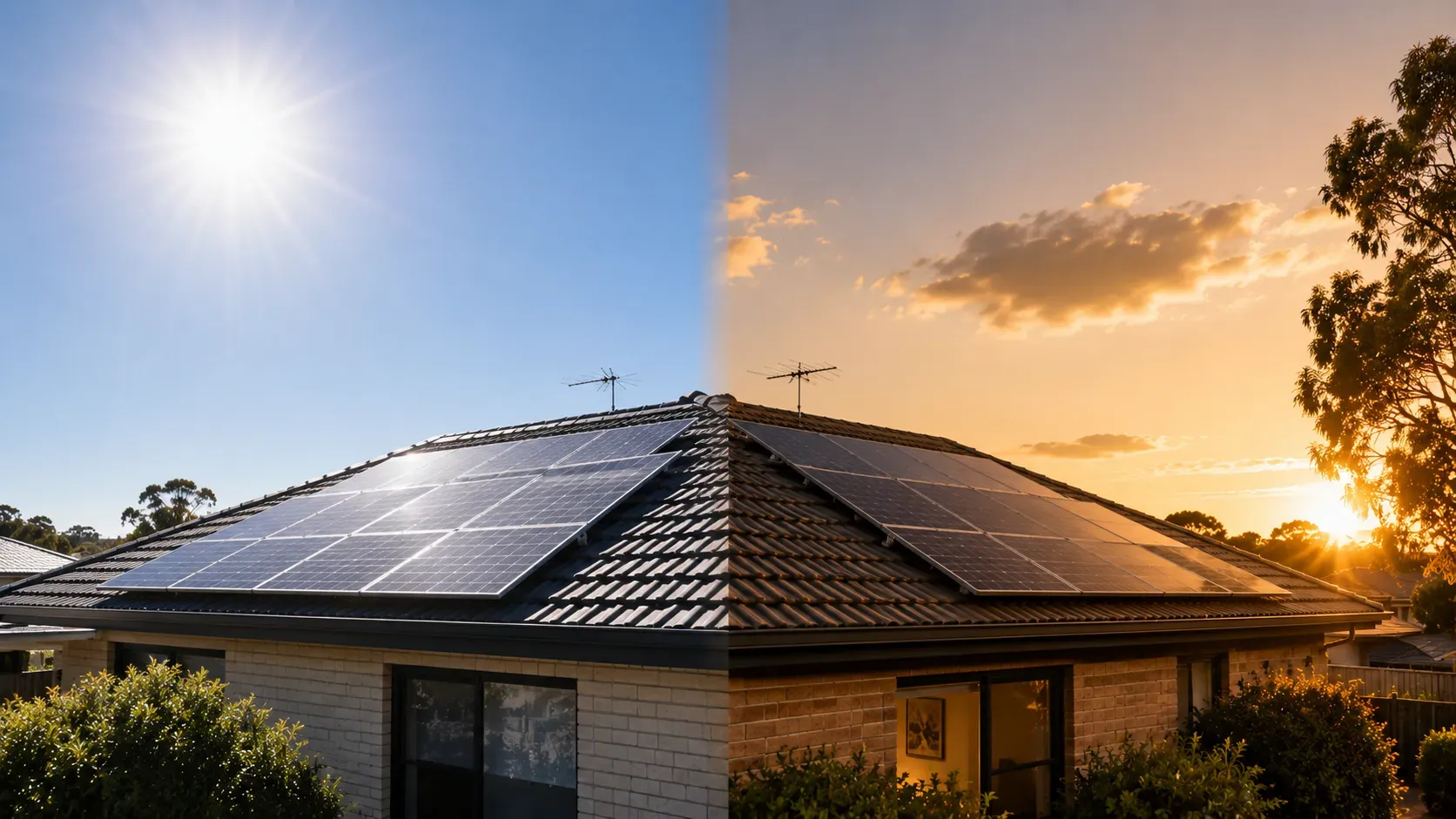
If you own solar in NSW, or you're about to get quotes, you've probably heard the phrase "sun tax" thrown around. It sounds scary. The reality, for most households, is a lot less dramatic — but it does change how a well-designed solar system should be quoted in 2026.
Here's what's actually happening, what it costs, and how to stay ahead of it.
What is a two-way tariff?
Traditionally, you paid to import electricity and got paid (a feed-in tariff) to export it. A two-way tariff adds a second price signal on the export side:
- A small charge for solar you export to the grid in the middle of the day (typically 10am–3pm), above a free threshold
- A reward payment for energy you export in the evening peak, when the grid actually needs it
The logic: on mild sunny days the grid is flooded with midday solar, and networks are spending money to manage it. Two-way pricing nudges exports away from midday and towards the evening.
Who's affected, and when?
All three NSW distribution networks now have two-way tariffs in play, and they've been shifting solar households onto them by default:
- Ausgrid (Sydney, Central Coast, Hunter) introduced its two-way tariff as opt-in from July 2024, and has applied it by default to export-ready customers since July 2025. It becomes mandatory — no more opting out — from 1 July 2028 (Ausgrid).
- Essential Energy (regional NSW) added an export charge and reward to its default "Sun Soaker" tariff from 1 July 2025. Existing customers can stay on their old tariff until 1 July 2028, after which export charges apply to everyone (Essential Energy).
- Endeavour Energy (Western Sydney, Illawarra) assigns new solar customers to its two-way "Residential Prosumer" tariff, with the ability to opt out until the end of the current pricing period (check Endeavour's current tariff terms).
One important nuance: these are network tariffs charged to your electricity retailer. Retailers choose how (and whether) to pass them through to your bill, so check your plan.
How much does it actually cost?
Less than the headlines suggest. Take Ausgrid's numbers: exports between 10am and 3pm are charged at 1.2c/kWh, but only above a free threshold of roughly 6.8kWh per day (about 205–212kWh per month). Exports between 4pm and 9pm earn a 2.3c/kWh reward. Ausgrid estimates a typical 5kW solar customer would pay about $13.30 a year in charges, offset by $6.70 in rewards — a net cost of around $6.60 a year, or 13 cents a week (Ausgrid fact sheet).
Essential Energy's charge is even smaller at 0.8277c/kWh above a 7.5kWh daily free threshold, while its evening reward is a generous 11.7212c/kWh between 5pm and 8pm.
So no, the sun tax won't wipe out your solar savings. But it does quietly change the economics of one popular strategy: oversizing a system purely to maximise midday exports. The bigger your midday export volume, the more you'll graze past the free threshold — and feed-in tariffs were already low.
How to come out ahead
The evening rewards are the hidden opportunity here. Ways to capture them:
Shift your self-consumption
Put your biggest appliances on timers so they draw power while the sun is up. Every kilowatt-hour you use yourself is worth far more than any export was, sun tax or not.
Consider a battery
A home battery soaks up midday solar (avoiding the charged window entirely) and can discharge into the 4pm–9pm reward window — earning a bonus on top of avoiding peak import prices. With the federal Cheaper Home Batteries Program cutting upfront battery costs — tiered by usable capacity, with the strongest support on the first 14kWh — the maths has genuinely shifted since two-way tariffs arrived.
Right-size, don't over-size
A good installer in 2026 should size your system around your actual usage pattern, not just "biggest array that fits".
What to ask when you get quotes
- How will a two-way tariff in my network area affect this system's payback estimate?
- Is the system sized for my self-consumption, or for maximum export?
- What would adding a battery (now or later) do to the numbers?
- Which retailers in my area pass the export charge through, and which don't?
Any installer worth their salt can answer these. If a quote's savings projection still assumes generous, unlimited feed-in earnings, treat it with caution — our solar tips cover more red flags to watch for.
The bottom line
The sun tax is real, but for a typical household it's a few dollars a year — not a reason to skip solar. It is a reason to design your system for 2026 conditions: self-consumption first, evening value second, midday exports last.
Thinking about solar or a battery? Compare up to 3 free quotes from pre-vetted local installers — get quotes today.