The best solar panels in Australia are the models that suit your roof, electricity needs and warranty expectations, not simply the highest-ranked brand. This guide compares 2 specific REC and Trina models, using manufacturer documents checked on 22 October 2026, to show how to assess the panels on your quote.
At a glance
- Compare the complete model code and wattage, not just the manufacturer's name.
- Rated watts describe test-condition power, not guaranteed daily electricity production.
- Product, performance and installation warranties cover different things.
- A higher-wattage panel is not automatically the best fit for your roof.
These are examples for Australian grid-connected households, not a national ranking, laboratory test or claim that either brand is best for everyone. Confirm the model available for your installation rather than assuming every product in a brand's range has the specifications below.
How do you choose the best solar panels Australia offers?
Start with the proposed system design, then compare the exact panels that fit it.
The Australian Government's panel guide recommends checking the approved module list, warranties, product reviews and Australian technical support. It also explains that manufacturer tier systems do not measure the quality of individual panels.
Treat “Tier 1” as a prompt for further questions, not proof that a particular module is the right purchase. Ask which model is being offered and what makes it suitable for your roof.
Separate three decisions: how much solar you need, which layout works, and which equipment meets that design. Our Australian solar system sizing guide helps with the first decision; a brand comparison should not replace it.
How do REC and Trina panel specifications compare?
The useful comparison is between identified wattage variants, not the maximum figure advertised for an entire family.
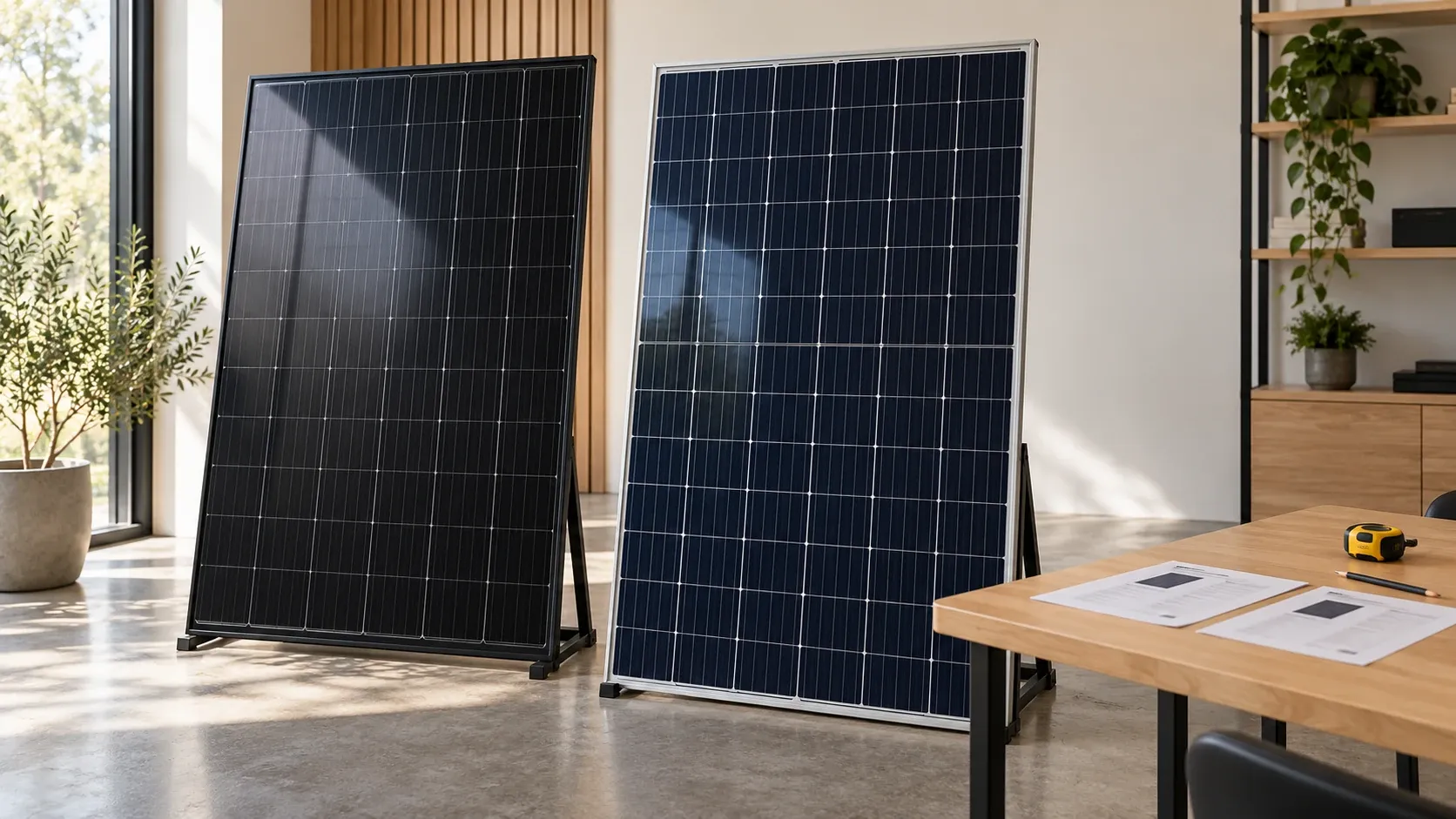
The table uses REC470AA Pure-RX from REC's Alpha Pure-RX datasheet and TSM-440NEG9R.28 from Trina's Australian Vertex S+ datasheet. These published specifications were checked on 22 October 2026; other wattage variants and revisions can differ.
| Published specification | REC470AA Pure-RX | Trina TSM-440NEG9R.28 |
|---|---|---|
| Rated power at standard test conditions | 470 W | 440 W |
| Module efficiency at that rating | 22.6% | 22.0% |
| Dimensions | 1728 × 1205 × 30 mm | 1762 × 1134 × 30 mm |
| Cell technology | Heterojunction | N-type i-TOPCon |
| Construction | Front glass with polymer backsheet | Dual glass |
| Product warranty advertised in the datasheet | 20 years standard; 25 years with eligible ProTrust cover | 25 years, subject to the Australian warranty supplement |
| Power warranty duration | 25 years | 30 years |
REC's example has a higher nameplate rating and efficiency, but it is also wider. Trina's example has a narrower footprint and a longer advertised power warranty; that does not establish a longer service life or better real-world generation.
Do not substitute a different Vertex S+ suffix or another REC Alpha model without repeating the comparison. Ask for the datasheet revision and Australian warranty documents with the quote, and have the installer confirm stock and the exact product listing before you sign.
Does higher efficiency mean more electricity from your roof?
Higher efficiency helps when usable roof area is limited, but the complete layout determines what you can install.
Energy.gov.au explains efficiency as the proportion of light energy converted into electricity. For panels of equal size, higher efficiency means higher rated capacity; comparing watts alone misses the effect of physical dimensions.
Ask for a roof drawing using the actual modules, with obstructions and shading identified. A narrower panel might permit a different arrangement, while a higher-rated panel might reach the target capacity with fewer modules.
Rated power is measured under standard test conditions. The government guide notes that actual output depends on location, weather, direction, slope, shading and other system factors, so neither the efficiency percentage nor panel count guarantees a daily yield.
For a fair comparison, request seasonal generation estimates for both layouts using the same assumptions. If one proposal assumes a sunnier roof or ignores shading, its forecast is not a clean test of the panel brand.
Which solar panel warranty should you compare first?
Compare the product warranty first, then examine performance and installation cover separately.
The government warranty guide distinguishes cover for faulty products from a performance warranty describing the minimum output of working panels. Workmanship cover concerns installation problems, such as a roof leak caused during installation.
For the REC model above, the datasheet lists standard product cover separately from ProTrust. The extended package requires an REC Certified Solar Professional installation and installer registration, with system-size limits and further conditions; do not assume the longer cover is automatic.
Trina's cited datasheet directs Australian buyers to its applicable warranty supplement. The headline duration is a starting point, not a substitute for checking exclusions and the process for a claim.
Ask who pays for diagnosis, access, removal, freight and reinstallation, and who you contact in Australia. Get those answers in writing rather than assuming a long performance warranty covers every expense.
What would a near-6.6 kW comparison look like for a Sydney home?
Different panel counts can produce almost the same rated system capacity, which makes layout and warranty differences easier to examine.
Consider an illustrative Sydney household, not a real customer. Assume it is comparing the two wattage variants above, both layouts can be safely accommodated, and the installer separately checks inverter compatibility and network requirements.
- Trina option: 15 × 440 W ÷ 1,000 = 6.60 kW of rated panel capacity.
- REC option: 14 × 470 W ÷ 1,000 = 6.58 kW of rated panel capacity.
The panel ratings come from the linked datasheets; the counts are chosen assumptions. The conversion follows the government's definition of system size.
Neither option is a generation forecast. The household should request layouts, seasonal output estimates and itemised installed quotes, keeping the inverter and installation scope comparable wherever possible.
If one option costs more, ask what the difference buys: a better-fitting layout, different warranty coverage or another documented benefit. There is no assumed price premium, savings figure or payback period in this example.
What should you check on your solar quote?
A usable quote identifies the equipment, design assumptions and responsibilities clearly enough to compare alternatives.
Use this checklist alongside our guide to solar quote red flags:
- Exact equipment: panel manufacturer, full model code, wattage, quantity and datasheet revision; inverter model listed separately.
- Real roof fit: module positions, shading assumptions and an explanation of why that layout suits the property.
- Comparable forecasts: the same usage information and weather assumptions for each proposal, with seasonal variation explained.
- Warranty documents: product and performance terms, any registration requirements, workmanship cover and the Australian claims contact.
- Complete scope: mounting, electrical work, access costs and exclusions, with any proposed substitution requiring your agreement.
Give every installer the same brief. Our solar buying tips can help you organise the wider comparison without turning a brand shortlist into a buying decision on its own.
Frequently asked questions
What brand of solar panel is best?
There is no universal winner for every Australian roof. The government panel guide recommends checking approved models, warranties and Australian technical support. Compare the exact model's efficiency, dimensions and warranty conditions against your proposed layout, rather than treating a manufacturer ranking as proof of suitability.
What size battery do I need for a 6.6 kW solar system?
A 6.6 kW panel rating alone cannot determine battery size. The government battery guide explains that storage uses surplus generation and that capacity and power output are different. Ask the installer to assess available surplus, evening demand and usable capacity before recommending a battery.
Which solar panel brand is better, Aiko or Jinko?
A brand-only comparison cannot settle which suits your home. This guide has not verified a like-for-like Aiko and Jinko model comparison, so it does not rank them. Apply the government's panel checks to the exact quoted models, including dimensions, efficiency, warranty conditions and Australian support.
Is 10kW solar enough to run a house?
It depends on electricity use, its timing and the site's generation conditions. The government sizing guide considers roof space, local sunshine, usage and budget. A panel capacity is not a promise of round-the-clock supply; ask for a seasonal assessment of generation and the electricity you would still import.
Compare before you commit
Choose the panel that makes sense within a well-explained system, not the brand with the loudest claim. Compare up to three free solar quotes through Your Solar Quotes, asking each installer for exact model details, a realistic roof layout and the warranty documents behind the headline promises.
Sources
- Australian Government, Solar panels, checked 22 October 2026.
- REC, Alpha Pure-RX datasheet, IEC EN 8.2026 V8, checked 22 October 2026.
- Trina Solar, Vertex S+ NEG9R.28 Australian datasheet, 2024 Aus C, checked 22 October 2026.
- Australian Government, Warranties and insurance, checked 22 October 2026.
- Australian Government, Size your solar system, checked 22 October 2026.
- Australian Government, Batteries, checked 22 October 2026.