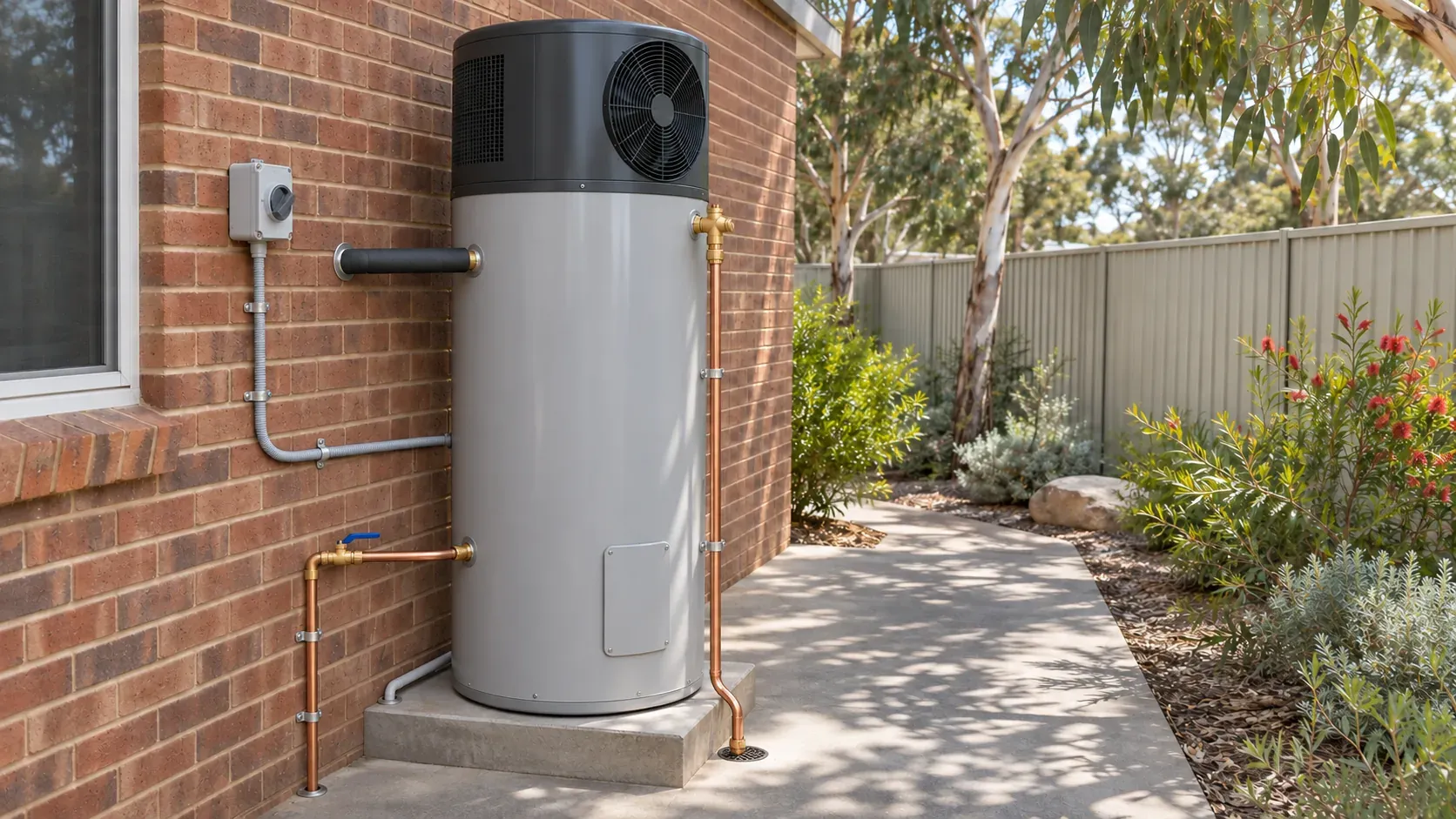
Heat pump hot water and solar can work together: your rooftop panels supply electricity while the heat pump moves heat from surrounding air into stored water. For Australian homes, daytime scheduling can increase solar use, but does not guarantee solar-only heating. Compare 3 options below, then check household demand, controls and tariffs.
At a glance
- A heat pump can run on household electricity without rooftop solar; photovoltaic panels can supply its electricity when generating.
- A daytime timer schedules heating, rather than measuring spare solar or guaranteeing no grid imports.
- Stored hot water can serve later demand, provided the tank and heating schedule suit your household.
- Keep hygiene protection enabled: saving money must not mean disabling safe heating cycles.
The Clean Energy Regulator explains heat pumps and daytime timers, while Your Home explains storage and control limitations.
How do heat pump hot water and solar work together?
Solar photovoltaic (PV) panels generate electricity; a heat pump uses electricity to move heat from the air into water. The regulator distinguishes this from solar thermal hot water, whose collectors capture the sun's heat directly.
The practical goal is to run the heater when your panels have electricity available after other household loads. The tank stores hot water for later use, not electricity. You do not need to buy a home battery simply to pair a heat pump with solar PV.
Start with your generation and consumption records, not the panel capacity alone. If you also run air conditioning, charge a car or charge a battery during daylight, ask the installer to assess those competing loads. Our solar system sizing guide explains why household consumption matters alongside roof space.
How does a heat pump compare with solar thermal and electric storage?
Compare the heating method and installation requirements before comparing prices. These distinctions follow Solar Victoria's technical buyer guide and Your Home's hot-water overview; the Victorian page is used for technology guidance, not state rebate advice.
| Option | How water is heated | What to check |
|---|---|---|
| Heat pump with solar PV | Electricity moves heat from air into stored water | Climate suitability, tank size and daytime control |
| Solar thermal hot water | Roof collectors capture heat directly, with supplementary heating | Roof suitability, shading and booster arrangements |
| Standard electric storage | A resistive element heats stored water directly | Electricity use, circuit and compatible scheduling |
Solar Victoria says heat pumps use less electricity than standard electric water heaters. That does not make every replacement equally worthwhile: compare the complete installed scope and expected operation against your existing system.
If your current heater still works, request a keep-and-control option as well as a replacement option. Ask what each proposal changes, what work is required and who will service it. A cheap-looking equipment price is not a complete installation comparison.
Will a daytime timer make hot water solar-only?
No: a timer chooses when the heater can operate, not where every unit of electricity comes from. Your Home warns that insufficient solar during the timer window means grid electricity is used instead.
Choose a schedule around your actual generation and hot-water demand. There is no universal clock window that suits every roof, season and household. Solar Victoria also notes that warmer daytime air can improve heat-pump efficiency, but this is not a guaranteed bill saving for every tariff.
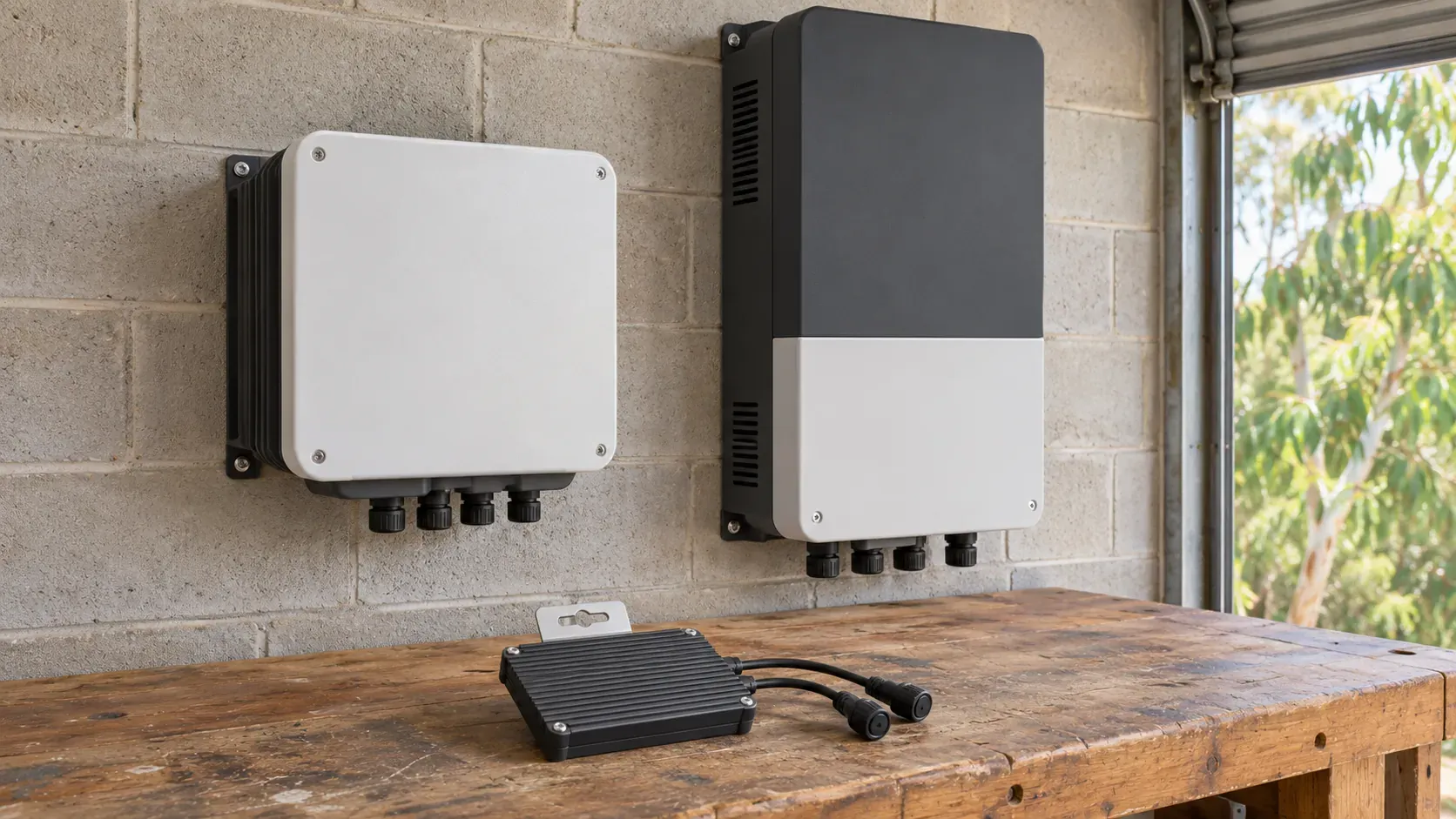
Compatible smart energy management can respond to available solar surplus rather than just a clock. Ask for written confirmation that the controller and exact heater model work together, including what happens on cloudy days. Do not assume a power-throttling diverter intended for a resistive element is suitable for a heat pump.
Have the installer check the supply circuit too. Your Home describes different controlled-load arrangements and model-specific compatibility; the old heater's circuit may not support the proposed daytime operation. Do not change wiring yourself or assume all off-peak electricity is supplied overnight.
What could daytime heating save in a hypothetical Brisbane home?
In this teaching example, shifting some heating from purchased electricity to spare solar reduces the daily energy cost by about $0.58, after allowing for lost export credits. This is a hypothetical Brisbane household, not a customer result, available electricity plan, market price or savings forecast.
Assume the same heat pump uses 3 kWh of electricity for the day's water heating under either schedule. With daytime operation, assume 2.4 kWh comes from solar that would otherwise be exported, leaving 0.6 kWh purchased from the grid.
For arithmetic only, assume imports cost $0.30/kWh and exports earn $0.06/kWh. These are invented teaching inputs, not current tariff observations.
- All-grid heating: 3 × $0.30 = $0.90.
- Daytime grid purchases: 0.6 × $0.30 = $0.18.
- Export income forgone: 2.4 × $0.06 = $0.144.
- Daytime economic cost: $0.18 + $0.144 = $0.324.
- Difference: $0.90 − $0.324 = $0.576, or approximately $0.58.
The export deduction matters: using your own solar can have an opportunity cost even when no electricity purchase appears on the bill. Our feed-in tariff comparison guide explains the export side of the decision.
This isolates scheduling, not the efficiency benefit of replacing an old heater. It holds energy use constant and excludes equipment costs, maintenance, fixed charges and demand charges. Replace the assumptions with your bill and measured or professionally estimated usage; do not multiply this sunny-day illustration into an annual promise.
What tank, climate and safety checks matter?
Choose a tank and recovery capability that cover your household's demand without compromising safe operation. Your Home explains that an undersized tank can run out or need reheating at less convenient times.
Tell the installer when people shower, whether baths are common and whether visitors change demand. Ask how the proposal handles a winter morning after heavy evening use, rather than selecting capacity from household headcount alone.
Check the model's operating-temperature range for your location. Heat pumps are not all identical in cold weather, and a brochure efficiency figure is not a household bill forecast.
Your Home notes that some models have a boost element and frequent use can increase running costs. Ask whether the quoted model has one, when it operates and how you can see its use. Also have the installer assess fan noise, nearby windows, airflow and service access before choosing a position.
Do not disable hygiene cycles or lower safe storage settings to chase solar savings. Your Home cautions against timer windows that interfere with protection against Legionella bacteria. Ask the installer to confirm safe storage heating and safe delivery temperature together, following the manufacturer's instructions and applicable requirements.
What should you check on your quote?
Ask for an itemised installation and a written operating plan, not just a tank model with a discount.
- Household fit: tank capacity, expected recovery, climate suitability and the demand assumptions used.
- Solar controls: exact timer or compatible controller, proposed schedule, circuit availability and cloudy-day operation.
- Installation scope: plumbing, electrical work, drainage, location, removal of the old unit and exclusions.
- Handover and support: operating instructions, boost controls, maintenance, warranty terms and the service contact.
- Discounts: the basis of any small-scale technology certificate assignment, shown separately from the complete installed total.
The Clean Energy Regulator says only certain registered models qualify for small-scale technology certificates (STCs) under the Small-scale Renewable Energy Scheme. Capacity and installation requirements also apply, including relevant state or territory installer licensing; a brand name or register entry alone does not settle eligibility.
Assigning certificate rights to an agent can provide a purchase discount, but the regulator does not set the agent's certificate price. Check the paperwork and avoid deducting the same discount twice. This guide does not verify state incentives or quote an installed-price range.
Frequently asked questions
Is heat pump or solar hot water better?
Neither wins for every home. A heat pump uses electricity and ambient heat; solar thermal uses roof collectors and supplementary heating. Solar Victoria recommends considering existing power supply and site conditions. Compare your roof, climate, hot-water demand and complete installation, remembering that a heat pump can also use rooftop solar electricity.
Why don't plumbers like heat pumps?
There is no evidence here that plumbers generally dislike heat pumps. If an installer advises against one, ask for the specific reason for your property. The regulator identifies usage, existing power supply, location and budget as selection factors. Compare that explanation with another appropriately licensed installer's assessment rather than assuming an industry-wide view.
What are the disadvantages of heat pump hot water?
Practical constraints include equipment space, fan noise and matching recovery to household demand. Some models use a boost element, which can increase running costs when used frequently. Your Home describes these considerations. Ask about the exact model, climate suitability, siting and service arrangements rather than treating every heat pump as identical.
Why is my bill so high with a heat pump?
A high bill needs investigation, not an automatic conclusion that the heat pump is faulty. Check hot-water use, heating times, tariff and booster operation. Your Home notes that timers can still draw grid power when solar is insufficient. Ask your installer to review settings and measured consumption before changing safe heating controls.
Compare before you commit
Bring your hot-water plans into your solar comparison. Compare up to three free solar quotes through Your Solar Quotes and ask how the proposed generation fits your daytime loads. Confirm hot-water installation and control responsibilities separately, so the solar and plumbing proposals agree rather than leaving integration to you.
Sources
- Clean Energy Regulator: Solar water heaters and air source heat pumps, checked 12 November 2026.
- Solar Victoria: Choosing between a heat pump and solar hot water system, checked 12 November 2026; technical guidance only.
- Australian Government, Your Home: Hot water systems, reader text checked 12 November 2026. Direct-site access could not be confirmed; used for technical guidance, not current legal or incentive rules.