
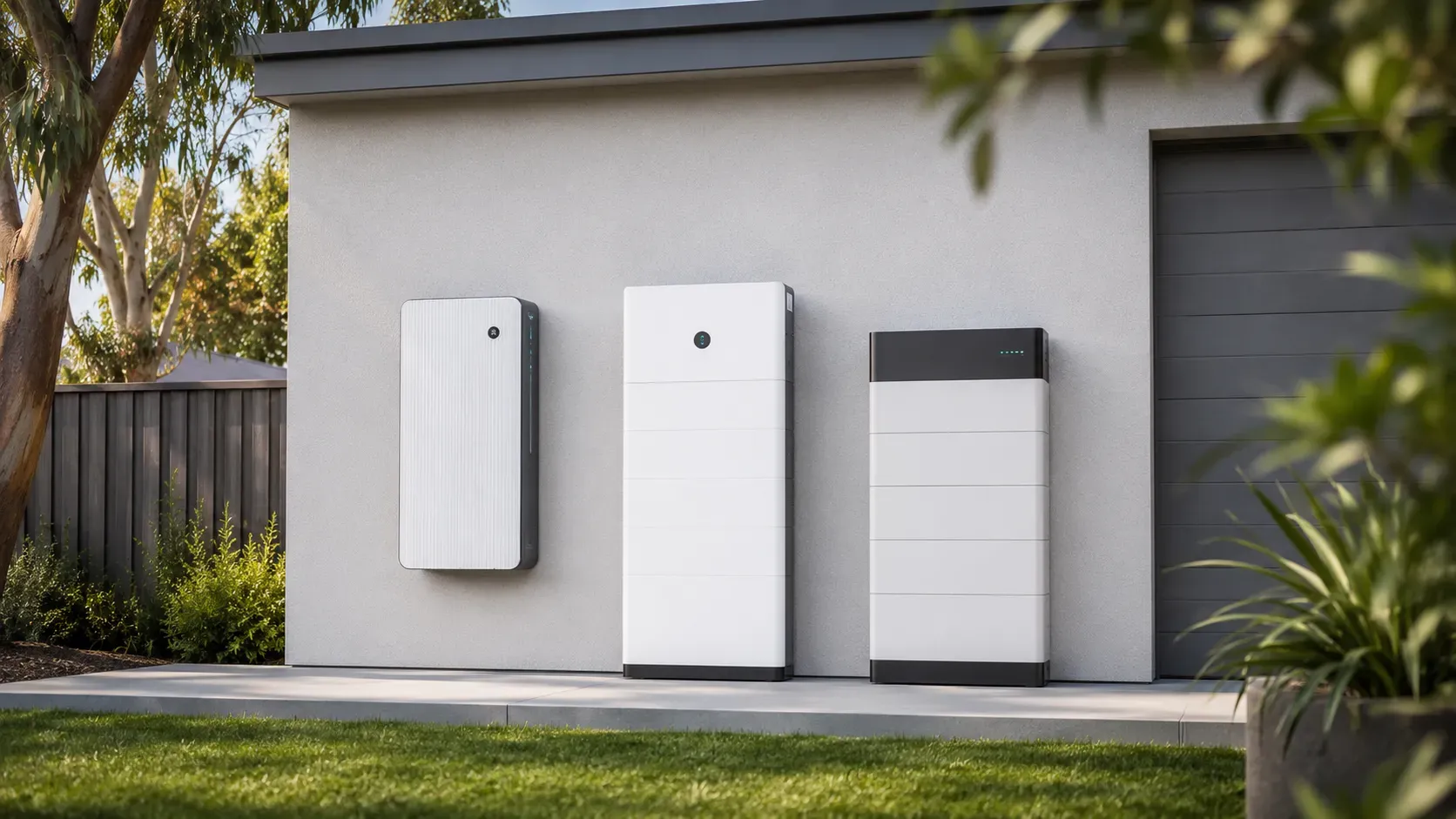
Ask three installers which home battery to buy in 2026 and you'll likely get three different answers — often the brand they happen to carry. So rather than crowning a winner, let's do something more useful: walk through how Tesla's Powerwall 3, Sigenergy's SigenStor, Sungrow's SBH and BYD's Battery-Box actually differ, and which comparison criteria matter for your home.
The four contenders at a glance
- Tesla Powerwall 3 — a fixed 13.5kWh usable unit with a built-in solar inverter. Capacity grows in big jumps: each expansion pack adds another 13.5kWh, up to around 54kWh per system.
- Sigenergy SigenStor — a stackable "5-in-1" system combining battery modules, inverter and energy management (with an optional EV charger). Modules stack to build capacity in smaller increments, scaling to very large systems.
- Sungrow SBH — a high-voltage modular system built from 5kWh modules (per Sungrow's specifications), pairing with Sungrow hybrid inverters and scaling from a mid-size stack to 40kWh and beyond in parallel.
- BYD Battery-Box Premium HVM — a modular tower from one of the world's biggest battery makers, configurable across roughly 8–22kWh per tower (per BYD's specifications) and paired with a separate compatible inverter.
Broadly: Tesla sells a polished all-in-one appliance, while the other three sell building blocks you size to fit. Neither approach is "better" — they suit different homes.
Criterion 1: usable capacity vs the 14kWh tier
Since 1 May 2026, the federal Cheaper Home Batteries Program pays the full STC rate only on the first 14kWh of usable capacity, then 60% up to 28kWh and 15% up to 50kWh.
This makes each brand's sizing steps genuinely interesting:
- A single Powerwall 3 at 13.5kWh sits neatly under the full-rate threshold. But its next step up is a 13.5kWh expansion — taking you to 27kWh, deep into the 60% tier.
- Modular systems (Sigenergy, Sungrow, BYD) can land much closer to 14kWh, or step past it in small increments, so you only pay reduced-tier money for capacity you've deliberately chosen.
Neither is automatically the right call — a bigger battery can still stack up if your evening usage justifies it. Just make sure your quote shows the tier maths, and confirm current STC values with your installer. Our solar battery guide covers sizing in more detail.
Criterion 2: backup capability
All four can keep your lights on in a blackout, but the details differ. Ask every installer:
- Is backup whole-home or essential circuits only?
- What extra hardware (gateway or backup box) is needed, and is it itemised in the quote?
- How fast is switchover? Sigenergy, for instance, markets near-seamless sub-10-millisecond switching; others may have a brief flicker.
Backup hardware is a classic hidden extra — a "cheaper" battery quote can quietly exclude it.
Criterion 3: modularity and future expansion
Think about where your household is heading — an EV, a heat pump, teenagers. Modular systems let you add a module later; the Powerwall grows in 13.5kWh chunks. But remember the rebate is claimed per install, and scheme support steps down over time (the whole program winds down to 2030), so "buy small now, expand later" can mean less support on the later capacity. Sometimes right-sizing once is the smarter move.
Criterion 4: warranty — read the fine print
All four brands offer 10-year warranties, but they're not equal. Compare:
- Guaranteed retained capacity at year 10 (often around 70%)
- Throughput or cycle caps — some warranties limit total energy delivered, which matters if you cycle hard in a VPP
- Whether the warranty covers the whole system (battery, inverter, gateway) or just the cells
Criterion 5: VPP compatibility and inverter integration
Every battery installed under the federal program must be VPP-capable (joining stays optional), so check which virtual power plants actually support your chosen brand in your state. Also weigh integration: Powerwall 3 and SigenStor include their own inverter, while Sungrow SBH and BYD pair with separate hybrid inverters — a great path if you're choosing your inverter brand anyway, or already own a compatible one.
So which one is right for you?
Honestly — it depends on your usage, roof, switchboard and budget, which is exactly why the installer matters as much as the box. Before you sign anything, browse the 15,000+ verified customer experiences at solar reviews to see how these brands and their installers perform in the real world, and check current incentives in our rebates guide.
Ready to see real numbers for your home? Get quotes from up to 3 trusted local installers — free and no obligation — and compare Powerwall, Sigenergy, Sungrow and BYD proposals side by side.