Yes, you can add battery to existing solar, subject to equipment compatibility and a compliant installation. There are 2 main connection approaches: AC and DC coupling. As checked on 29 October 2026, eligible Australian retrofits can receive federal battery support. Keeping your present inverter and obtaining blackout backup both require a design check, not an assumption.
At a glance
- The Australian Government's Solar Consumer Guide identifies AC coupling as the usual arrangement for adding a battery to existing solar.
- A battery's kWh measures stored energy; its kW output limits the appliances it can supply simultaneously.
- Backup must be supported and configured: a battery does not automatically keep your whole home running during an outage.
- The Clean Energy Regulator's battery rules allow eligible systems with 5–100 kWh nominal capacity, with certificate support limited to the first 50 kWh usable.
How can you add battery to existing solar?
You can connect storage through a separate battery inverter or through a compatible hybrid inverter serving both solar and battery.
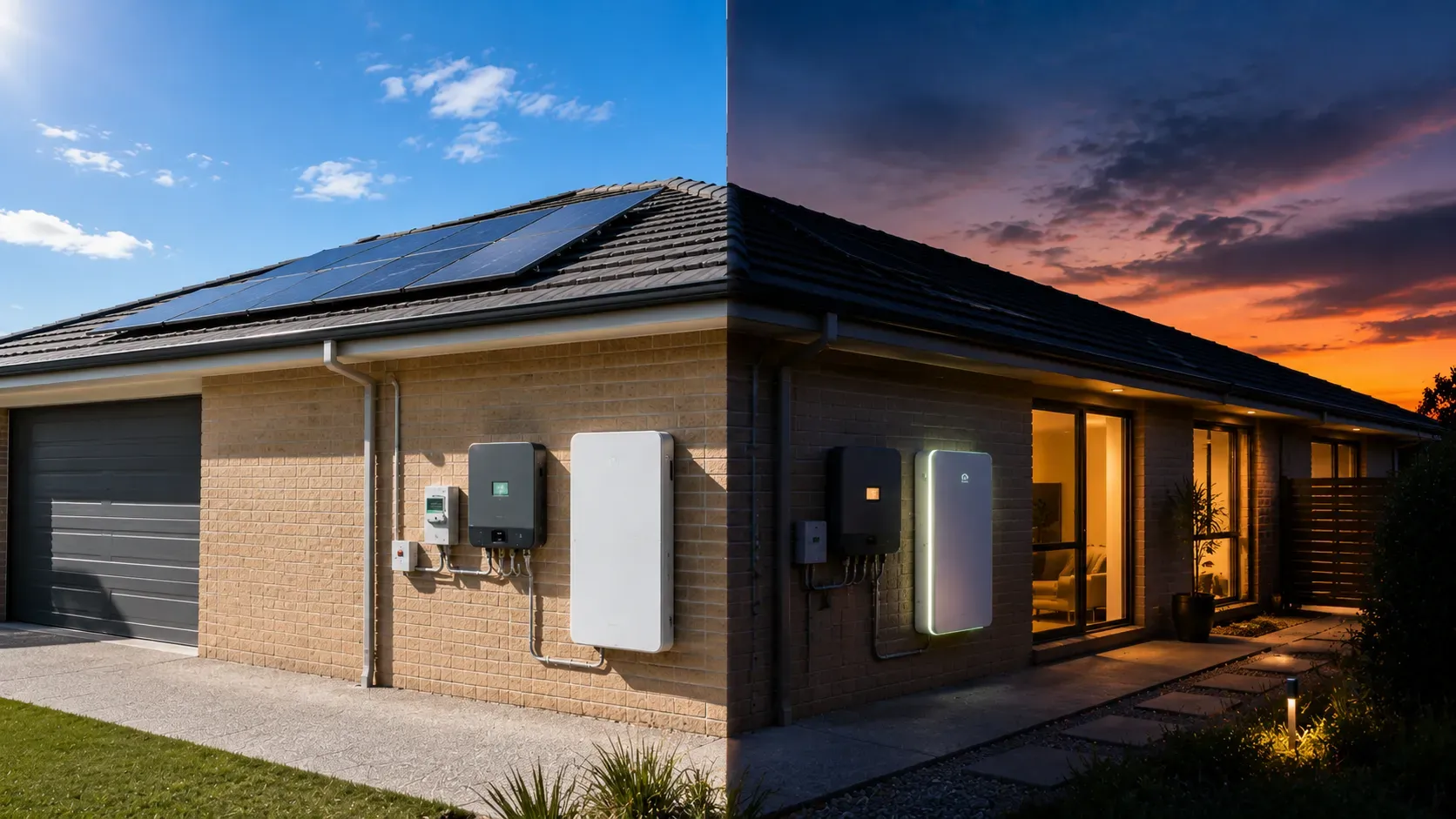
The Solar Consumer Guide explains that AC coupling uses two inverter functions. Your solar inverter converts the panels' direct current into alternating current; a battery inverter converts that AC back to DC for charging and converts stored energy back to AC when supplying the home. Some batteries include their battery inverter.
With DC coupling, solar and battery share a hybrid inverter, and solar DC can charge the battery directly. The relevant question is which complete arrangement suits your existing equipment and requirements, rather than which label sounds newer.
| Connection approach | What the arrangement involves | What to ask the designer |
|---|---|---|
| AC-coupled retrofit | Solar inverter plus a separate or battery-integrated inverter | Can the existing solar inverter stay, and how will both systems be controlled? |
| DC-coupled retrofit | Solar and battery connected through a compatible hybrid inverter | Does the existing hybrid inverter qualify, or is replacement included? |
This is a design comparison, not a promise that any battery will work with any inverter. Request the exact equipment pairing and proposed operating behaviour in writing.
Can you keep your existing panels and inverter?
You may be able to retain them, but the existing solar installation and battery-connected inverter have different eligibility checks.
The regulator says existing solar must comply with state and territory electrical safety regulations; the existing solar system does not have to be on the current approved-product list. That does not waive safety requirements or establish that a particular ageing installation is suitable.
For federal support, an existing hybrid inverter connected to the battery must be virtual power plant (VPP) capable and either currently approved or listed when the solar system was commissioned. If it is no longer listed, it must not have been declared ineligible or delisted for safety reasons. Other existing solar inverters on site do not have to be VPP-capable under this requirement.
Send installers the inverter's exact model, installation records and monitoring information. Ask whether it stays, what replaces it if necessary, and which manufacturer documents support the proposed pairing. A vague “battery-ready” description is not the model-specific evidence you need.
How much will a battery retrofit cost?
The useful comparison is the complete installed scope after clearly itemised support, not the battery box alone.
We have not verified a like-for-like current national retrofit price range for this guide, so we do not present one. A price without comparable usable capacity, inverter work, backup scope and rebate treatment would not reliably answer your buying question.
Ask each installer to separate battery equipment, any inverter replacement, electrical work and the backup configuration you requested. Require the full price including GST, the certificate discount, exclusions and final amount payable. If a price is already after incentives, do not subtract the same support again.
Where both connection approaches are feasible, request alternatives against the same requirements. Compare the cost of keeping equipment with the cost of replacing it, without assuming either route must be cheaper. Our three-quote comparison checklist helps keep the comparison consistent.
Can an existing-solar household get the federal battery rebate?
Yes: the Cheaper Home Batteries Program supports eligible batteries installed with existing solar, not only packages containing new panels.
The government's eligibility guidance and regulator both require qualifying equipment and installation. Support operates through small-scale technology certificates (STCs), rather than an unconditional cash payment to every buyer. Assigning certificate rights to a registered agent can provide an upfront discount.
For grid-connected homes, the battery system, including its inverter, must be VPP-capable. Joining a VPP is not required by the federal program, although a separate state incentive or commercial offer needs its own terms checked.
Only one battery system can receive support at a premises under the program. Do not confuse having previously received solar-panel STCs with having already claimed battery STCs; disclose the site's battery history before an installer calculates eligibility.
The national battery program guide provides wider context. Ask for the certificate calculation and actual discount separately: eligible capacity is not a fixed dollar entitlement, and a quoted percentage is not a substitute for the calculation.
How should you size storage and specify backup?
Start with when you import electricity, the solar energy available to store and the circuits you want supported during an outage.
The regulator recommends reviewing present and future electricity use. Provide interval import/export data where available, alongside solar monitoring, rather than choosing storage only from the panels' nameplate rating. Compare representative days across seasons; a sunny day's surplus does not establish winter charging availability.
The Solar Consumer Guide distinguishes stored energy from output power. A battery can have enough energy for a period but insufficient output for all appliances switched on together. Ask the designer to check both usable kWh and the required simultaneous load.
Backup is a separate design requirement. Some systems supply selected circuits only; in a three-phase property, backup may cover a single phase. Some arrangements stop solar generation during an outage, while an islandable solar-and-battery system can recharge from the panels when sunlight and operating conditions allow.
Specify the essential circuits and ask whether solar recharging works during a blackout. Do not accept “backup included” as a complete description. For the broader purchase decision, see our solar-only versus solar-and-battery guide.
What does an illustrative Brisbane household's energy check show?
A simple energy budget can reveal a mismatch before you treat a battery's advertised size as a solution.
Consider a hypothetical grid-connected Brisbane household, not a customer result. Assume a chosen day's solar surplus available for charging is 8 kWh, evening and overnight consumption is 9 kWh, and charging-to-delivery efficiency is 90%. That efficiency is an illustrative modelling assumption, not a verified specification for a quoted product.
- Energy delivered from that surplus: 8 × 0.90 = 7.2 kWh.
- Remaining energy requirement: 9 − 7.2 = 1.8 kWh.
- Surplus needed to deliver the full 9 kWh under the same assumption: 9 ÷ 0.90 = 10 kWh.
This assumes adequate storage capacity and power, no starting stored energy, no grid charging, no reserve withheld and no other energy flows. Actual performance also depends on timing, controls and conditions. A larger battery alone does not create the extra solar energy missing from this day's budget.
The calculation is not a savings or payback estimate. Repeat the assessment with your own data and the proposed system's specifications before selecting capacity.
What should you check on your quote?
Ask for a documented retrofit design, not just a battery model and a final price.
- Existing equipment: identify the panels and inverter being retained or replaced, with model-specific compatibility evidence.
- Complete scope: show usable capacity, output power, electrical work, backup circuits and outage recharging behaviour.
- Support: separate STCs from other discounts, check prior battery claims and specify any VPP contract conditions.
- Responsibilities: name who handles relevant network requirements, commissioning, monitoring access and future servicing.
- Safety and handover: identify the licensed electrical professional, battery accreditation and compliance documentation supplied.
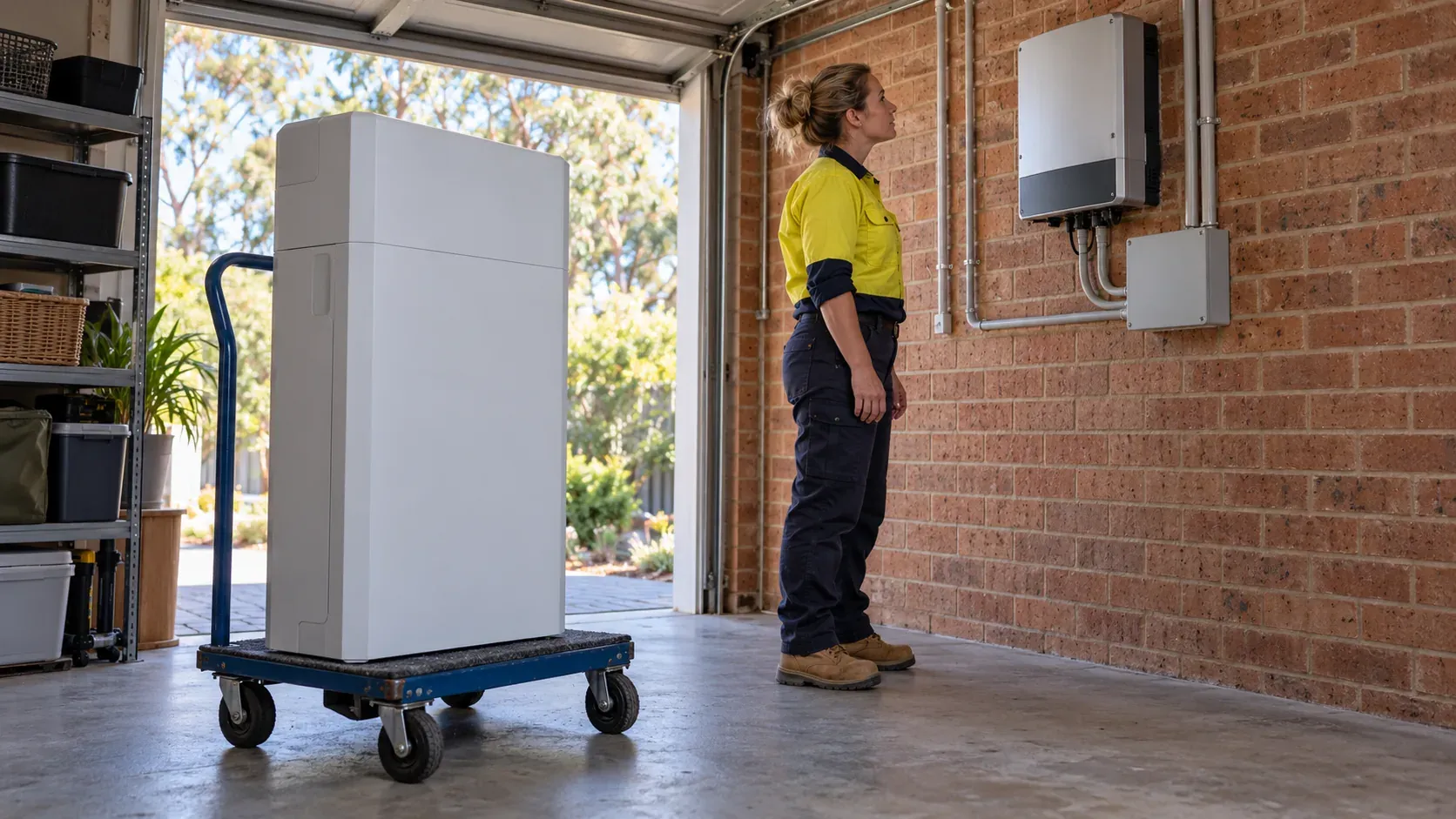
The regulator's installer guidance requires appropriate Solar Accreditation Australia accreditation, compliant installation and written statements. Have the qualified installer assess the battery location and required clearances; this guide is not an installation manual.
Frequently asked questions
Can I add a battery to my solar system myself?
Treat a fixed household battery retrofit as professional electrical work, not a DIY connection. Electrical wiring must be done by a licensed professional in the relevant state or territory. Federal support also requires the appropriate battery installer accreditation and compliant equipment, installation and documentation. Collect records rather than opening electrical enclosures yourself.
How much does it cost to add a battery to an existing solar system?
There is no verified universal price in this guide. Compare complete installed quotes with the same usable capacity, inverter scope and backup requirements. Ask for GST, electrical work, certificate support and exclusions to be itemised, then compare the final payable amounts without subtracting an already-included discount twice.
Can I add a battery to my solar system later?
Yes, adding storage later is possible, subject to a suitable design and compliant installation. AC coupling is the usual retrofit arrangement identified by the Australian Government's Solar Consumer Guide. Check the exact inverter model and battery pairing rather than assuming every system described as battery-ready accepts every battery.
How long will a 10kW battery power my house?
First check the unit: 10 kW describes power, not stored energy. Runtime depends on usable kWh, charge remaining, household load and the configured reserve. Backup must also support the intended circuits. Ask the designer for an estimate using your essential loads, not a whole-home runtime promised from a power rating alone.
Compare before you commit
Give every installer the same existing-equipment details, energy data and backup requirements. Your Solar Quotes can help you compare up to three free solar and battery quotes, so you can assess the complete retrofit rather than three differently scoped battery prices.
Sources
- Australian Government: Batteries — Solar Consumer Guide, checked 29 October 2026.
- Clean Energy Regulator: Solar batteries, checked 29 October 2026.
- DCCEEW: Eligibility information for the Cheaper Home Batteries Program, checked 29 October 2026.
- Clean Energy Regulator: Solar battery installers and designers, checked 29 October 2026.