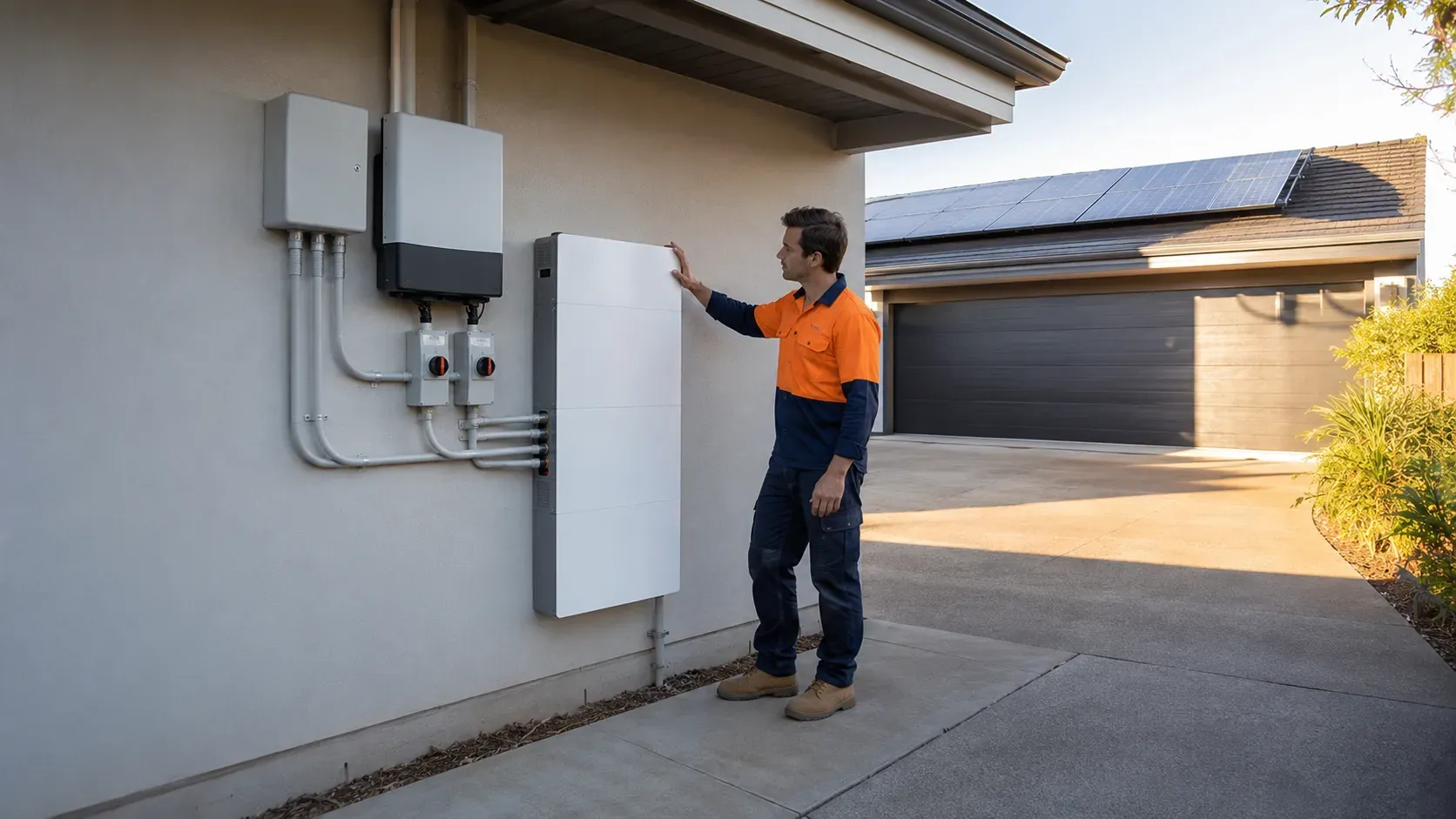
The NSW battery rebate question has two parts: eligible households can combine the federal battery discount with NSW's virtual power plant (VPP) connection incentive. As at 15 October 2026, NSW accepts eligible batteries up to 50 kWh, but rewards capacity made available to the grid only up to 28 kWh. Payment depends on the provider's offer.
At a glance
- NSW's old household battery installation discount is no longer available; the federal program provides installation support instead.
- The NSW VPP incentive is available with no current closing date, as checked on 15 October 2026.
- NSW increased its VPP battery eligibility ceiling to 50 kWh from 1 July 2026; the rewarded capacity remains capped at 28 kWh.
- For on-grid federal support, VPP capability is required but joining is optional. Claiming NSW's VPP incentive requires participation.
What does the NSW battery rebate cover in 2026?
For a household, separate the federal installation discount from the NSW payment for connecting an eligible battery to a participating VPP. They support different decisions, so a quote should not roll them into one unexplained rebate.
The federal Cheaper Home Batteries Program operates through small-scale technology certificates (STCs). An eligible installation can generate certificates that underpin a discount; certificate quantity is not itself a dollar saving.
NSW's incentive concerns joining a VPP, which coordinates connected batteries to provide power to the grid. The state says its incentive can be combined with federal support, provided you satisfy the requirements of both programs.
That does not mean every federal-eligible battery qualifies for every NSW offer. Your hardware, retailer and provider's contract need a separate check, even when the installer describes the battery as VPP-ready.
For a broader explanation of the installation discount, start with our Cheaper Home Batteries Program guide. This article focuses on the NSW combination rather than assuming a national battery offer applies unchanged to your home.
Which eligibility rules should you compare?
Check federal installation eligibility and NSW VPP eligibility separately, using the actual battery model rather than its marketing name. The programs use different capacity limits and reward different things.
The Clean Energy Regulator's battery requirements set federal eligibility at 5–100 kWh nominal capacity, with STCs limited to the first 50 kWh of usable capacity. Eligible batteries must be connected to new or existing solar, use approved equipment and meet installation requirements, including an appropriately accredited installer.
| Check | Federal battery support | NSW VPP incentive |
|---|---|---|
| What attracts support? | An eligible battery installation | Connecting an eligible battery to a participating VPP |
| Which upper limit matters? | 100 kWh nominal eligibility; first 50 kWh usable attracts STCs | Up to 50 kWh eligible; incentive calculation capped at 28 kWh made available to the grid |
| Is VPP membership required? | Not for federal support; on-grid equipment must be capable | Yes, through a provider offering the NSW incentive |
| What should the quote show? | Certificate calculation and discount | Separate payment amount, timing and participation conditions |
Nominal capacity, usable capacity and capacity made available to the grid are not interchangeable. Ask the installer and VPP provider to identify each relevant figure in writing rather than applying a single capacity label to both calculations.
NSW providers can restrict supported equipment and locations, and you may need to change electricity retailer. A system that fits the government's capacity ceiling can still be incompatible with a particular provider's offer.
How much will the NSW VPP incentive pay?
There is no single current dollar payment that every NSW household receives. NSW's maintained guidance says the amount varies with the provider, contract and battery capacity made available to the grid, up to the rewarded limit.
Ask for a written offer showing whether payment arrives upfront, in instalments or as electricity bill credit. Do not subtract a future bill credit from the cash you need on installation day unless the supplier explicitly confirms that arrangement.
NSW says the incentive can be claimed once per National Metering Identifier (NMI), the identifier for your electricity connection. If a battery or VPP arrangement already exists at the property, have the provider check the connection's claim history before including another incentive in your budget.
Keep the NSW connection incentive separate from ongoing VPP earnings and any additional provider promotion. An advertised reward bundle may contain several components with different conditions; the useful comparison is what you receive, when, and what you agree to in return.
Do you have to join a VPP to get federal support?
No: the federal requirement for on-grid batteries is technical capability, not compulsory membership. NSW's connection incentive is different because participating in a qualifying VPP is the activity being rewarded.
The Department of Climate Change, Energy, the Environment and Water (DCCEEW) says participation needs an ongoing internet connection. Before signing, ask who controls charging and discharging, what energy reserve remains available to you, and what happens if your internet connection fails.
Read the electricity plan alongside the VPP contract. Ask about import rates, supply charges, export payments, fees, withdrawal conditions and battery warranty treatment, rather than comparing a joining incentive in isolation.
Our VPP decision guide covers the wider contract questions. For this NSW decision, insist that the provider distinguishes government incentive conditions from its own commercial terms and supplies the current offer rather than an older promotional example.
How would the calculation work for a Sydney household?
An illustrative Sydney household with a new eligible 10 kWh usable battery can compare certificate quantities without inventing a VPP payment. Assume the battery is entirely within the first federal capacity tier, all eligibility requirements are met, and the installation falls within the stated factor period.
The regulator's factor table sets the factor at 6.8 STCs per usable kWh for May–December 2026, with the first 14 kWh receiving the full factor. For January–June 2027, the factor is 5.7; our January battery rebate step-down guide explains the timing in more detail.
- Installation in the May–December 2026 period: 10 × 6.8 = 68 STCs.
- The same eligible capacity in January–June 2027: 10 × 5.7 = 57 STCs.
- Difference: 68 − 57 = 11 STCs, not a guaranteed dollar difference.
This is a hypothetical calculation, not a customer result, installed-price quote or recommendation to rush a purchase. Your actual discount also depends on the certificate value and the supplier's stated fees and terms.
For the federal timing rule, DCCEEW defines installation by the date the electrical compliance certificate is issued, not when you pay a deposit. The later window for creating certificates does not preserve an earlier installation-period factor.
The household should then add a separate line for the NSW VPP offer only after the provider confirms eligibility and payment terms. Leaving that line unpriced is more honest than inserting an old statewide headline amount that the current offer does not promise.
What should you check on your battery quote?
Ask for an itemised quote that still makes sense if you decline the optional VPP membership. You should be able to see the hardware decision, federal discount and proposed NSW arrangement independently.
- Equipment and capacity: record the battery and inverter models, nominal and usable capacity, and the provider's confirmation that the combination is supported.
- Federal calculation: request the STC quantity, applicable factor period, discount and any fees; confirm who handles the certificates.
- Installation timing: ask what must happen before the electrical compliance certificate can be issued. A deposit or proposed fitting date is not the certificate date.
- NSW payment: obtain the provider's written eligibility decision, NMI check, payment amount and timing, plus any conditions attached to receiving it.
- Contract and retailer: compare energy rates, dispatch permissions, reserve settings, warranty treatment and exit conditions alongside the incentive.
- Total outlay: identify installation exclusions and distinguish money payable now from later credits or conditional rewards.
NSW's published process includes provider selection, nomination paperwork, a contract, a cooling-off period and onboarding. Ask the provider to explain the sequence before signing anything that assumes the incentive is already secured.
Frequently asked questions
How much is the NSW Government VPP incentive worth?
The amount depends on your provider's offer, contract and battery capacity made available to the grid, capped at 28 kWh for the incentive calculation. Compare written offers rather than treating an old advertised maximum as your entitlement. Confirm whether payment is upfront, instalments or bill credit.
Will the NSW solar battery rebate be available in 2026?
As at 15 October 2026, NSW's VPP connection incentive is available with no current closing date. The former NSW household battery installation discount is no longer available. Eligible households can instead combine federal battery installation support with the NSW VPP incentive, subject to each program's requirements.
Which VPP provider is best in NSW?
There is no provider that this guide can identify as best for every household. Compare offers supporting your battery and location, then check retailer compatibility, payment timing, dispatch control and exit conditions. Ask each provider to confirm that its current offer includes the NSW incentive, rather than assuming every VPP does.
Is a VPP worth it?
A VPP is worth considering when its payments and electricity plan suit your household and you accept the control conditions. Do not judge value from the connection incentive alone. Compare the full contract, including fees, reserve settings and withdrawal terms; federal support does not require on-grid households to join.
Compare before you commit
Compare the installed battery offer first, then judge the VPP contract on its own terms. We can help you compare three free solar and battery quotes, with no obligation; ask each installer to separate federal support, any NSW incentive and the amount you actually pay.
Sources
- NSW Government: Install a battery, checked 15 October 2026.
- NSW Government: Virtual power plant (VPP) incentive, checked 15 October 2026.
- Clean Energy Regulator: Solar batteries, checked 15 October 2026.
- DCCEEW: Eligibility information for the Cheaper Home Batteries Program, checked 15 October 2026.