Commercial solar rebates now extend to eligible Australian systems up to 1 MW installed from 1 October 2026, under the expanded federal scheme. NSW businesses can also access commercial battery discounts. These are separate incentives: eligibility, installation timing and certificate processing matter more than a headline percentage when you compare quotes.
At a glance — checked 6 October 2026
- Nationally, the Clean Energy Regulator says mid-scale solar applications will open in mid-to-late November 2026, although eligible installations date from 1 October.
- Eligible mid-scale solar receives a fixed five-year deeming period, unlike smaller solar systems whose deeming period declines annually.
- In NSW, indicative battery installation discounts are 20–30% for battery-only projects or 30–40% with qualifying new solar. Those percentages are not discounts on the entire solar-and-battery project.
- The separate federal battery program supports eligible 5–100 kWh nominal systems, with certificates limited to the first 50 kWh of usable capacity. A large commercial battery does not automatically qualify.
What changed with commercial solar rebates in October 2026?
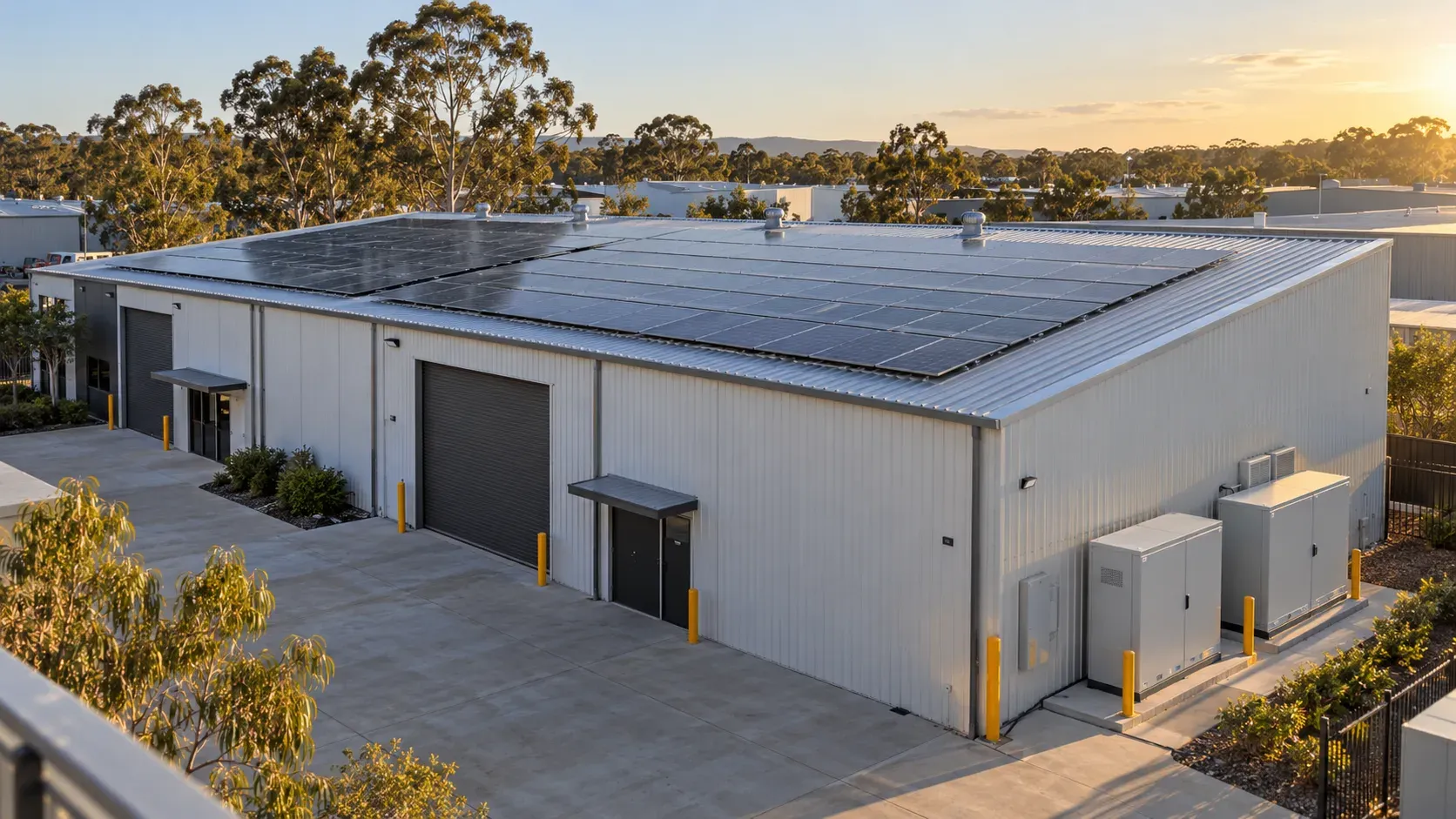
Eligible mid-scale solar can now earn an upfront certificate benefit, with the federal Small-scale Renewable Energy Scheme (SRES) expanded from 100 kW to 1 MW.
The Clean Energy Regulator's current guidance confirms the regulations have been amended. This is no longer just an announcement awaiting regulations, but it is not yet an open application process: the regulator must finish implementing its systems before applications and assessment begin.
Small-scale technology certificates (STCs) underpin the financial benefit. For a warehouse, workshop or manufacturer considering a larger roof installation, the expansion is a reason to revisit the design rather than automatically stopping at the old threshold.
Ask whether STCs or Renewable Electricity Guarantee of Origin (REGO) participation better suits your project. The regulator says taking STCs prevents REGO certificate creation during the deeming period.
It is not a reason to fill every available roof section. Ask the designer to compare capacity against your interval consumption, shading, roof condition and network connection constraints. More panels only help the business case if the extra generation has sufficient value.
Which solar and battery incentives should your business compare?
Separate the solar array from the battery, then check each incentive against its own capacity, location and installation rules.
This table summarises the federal solar expansion, NSW business battery incentive and federal battery eligibility rules checked on 6 October 2026.
| Incentive | Where and what it covers | Main purchase check |
|---|---|---|
| Expanded solar SRES | Eligible Australian mid-scale solar above 100 kW and up to 1 MW, installed from 1 October 2026 | Applications open later; confirm who carries certificate-processing risk |
| NSW battery-only incentive | Eligible NSW business batteries above 20 kWh and up to 30 MWh usable | Indicative 20–30% battery installation discount; eligibility is not determined by size alone |
| NSW battery with qualifying new solar | Eligible NSW business battery plus new or additional solar | Indicative 30–40% battery installation discount; solar timing and sizing conditions apply |
| Cheaper Home Batteries Program | Eligible Australian residential and non-residential batteries of 5–100 kWh nominal capacity | STCs apply only to the first 50 kWh usable; solar connection and other conditions apply |
This guide focuses on the federal changes and NSW commercial storage, not every state program. Do not assume NSW's percentages apply elsewhere, or that household offers cover an industrial site.
What does NSW require for the larger battery discount?
NSW requires qualifying new or additional solar, not simply an existing solar array.
The operative NSW rule separates BESS4 (above 20–200 kWh usable) from BESS5 (above 200 kWh–30 MWh usable). Exactly 200 kWh falls under BESS4. NSW defines usable capacity as 90% of nominal capacity; do not substitute a different manufacturer or federal definition. BESS4 also requires a genuine minimum customer contribution of $5,000 excluding GST.
The NSW business program page states that new solar must be installed within 90 days before or after the battery. The rule requires new or additional solar capacity in kW to be at least one-quarter of the scheme-defined usable battery capacity in kWh. Ask the installer and Accredited Certificate Provider to document that sizing test.
NSW advertises a 1 September 2026 launch, but the current rule specifies installations completed on or after 7 September 2026. Refer any 1–6 September project to the provider rather than assuming eligibility. There is no current closing date on the program page. Businesses must be grid-connected, obtain required approvals and not have previously used BESS4 or BESS5; residential buildings and data centres are excluded.
There is also a paperwork trap. The nomination form must be signed and returned before installation begins; the program does not reimburse completed work retrospectively. Ask which Accredited Certificate Provider handles your project and check that the quoted discount is written into the agreed scope.
Can you combine federal and NSW incentives?
Yes, where the project meets both programs' requirements, but distinguish federal support for the solar panels from federal support for the battery.
NSW expressly allows its business battery discount to be combined with federal solar discounts and, separately, eligible federal battery discounts. That is conditional permission, not proof that every commercial system gets every incentive.
For example, a proposed 400 kWh nominal battery exceeds the federal battery program's 100 kWh nominal ceiling. It cannot receive that federal battery discount simply because NSW's business incentive accommodates larger storage. Federal battery support also requires associated solar of no more than 100 kW. The solar array's federal eligibility is a separate question.
Our federal battery step-down guide explains the smaller-battery timing rules. Keep those distinct from the fixed deeming period for newly eligible mid-scale solar: the same calendar change does not affect every certificate calculation in the same way.
How would you test a Sydney warehouse proposal?
Calculate the incentive's effect on capital cost separately from the battery's annual operating benefit, then test both assumptions.
Consider an illustrative Sydney warehouse, not a customer case study. Assume its proposed battery has 400 kWh nominal capacity, qualifies for the NSW incentive and has been assessed against the site's actual load and tariff. The following figures are deliberately hypothetical arithmetic inputs, not market prices, a quote or a rebate entitlement:
| Assumed input | Illustrative amount |
|---|---|
| Battery installed cost before NSW discount | $120,000 |
| Written NSW discount assumed for this example | $36,000 |
| Annual operating benefit before maintenance and finance | $12,000 |
The resulting calculations are:
- Net battery capital cost: $120,000 − $36,000 = $84,000.
- Simplified capital recovery: $84,000 ÷ $12,000 = 7 years, versus 10 years without the assumed discount.
- Lower-benefit sensitivity: if annual benefit is only $8,000, $84,000 ÷ $8,000 = 10.5 years.
This is not a forecast or a full investment appraisal. It omits maintenance, finance, degradation, tax and the time value of money; all prices use the same assumed accounting basis. Solar capital cost and solar incentives are excluded so they are not counted twice.
The useful lesson is that an attractive discount cannot rescue weak operating assumptions. Ask for annual savings modelled from your meter data, including storage losses, export income forgone and any demand-charge reduction actually achievable under your tariff. Our business utility planning article provides broader context for comparing competing site upgrades.
What should appear on your commercial solar and battery quote?
Your quote should separate equipment, incentives, annual benefits and delivery conditions so you can compare proposals on the same basis.
Ask each installer for:
- A complete design: panel capacity in kW, battery power in kW, nominal and usable storage in kWh, and the installation work included.
- Separate incentive lines: solar STCs, any federal battery STCs and NSW support, with eligibility evidence and any administration charges.
- Timing and payment terms: the assumed installation date, certificate-processing arrangements and who pays if a discount is delayed or rejected.
- NSW documentation: the Accredited Certificate Provider, nomination form, solar-pairing conditions and approvals needed before work begins.
- A credible operating model: interval consumption, tariffs, self-consumption, losses, export restrictions, maintenance and clearly specified backup capability.
Keep tax treatment and funding decisions with your accountant or finance provider. Compare the underlying project before selecting how to fund it, and do not accept an incentive estimate as a substitute for network or planning approval. Our commercial solar guide covers system sizing, typical costs, finance options and maintenance in more detail.
Frequently asked questions
Are solar rebates changing in 2026?
Yes. The federal SRES expansion applies to eligible mid-scale solar installed from 1 October 2026, extending support up to 1 MW. Applications are not due to open until mid-to-late November. Solar and battery incentives have separate rules, so confirm which technology and installation period your quote assumes.
What is the STC rebate for 2026?
There is no single dollar amount applying to every solar installation. The Clean Energy Regulator distinguishes declining small-scale deeming periods from the fixed five-year mid-scale period. Ask your installer to show the certificate calculation and the actual discount being passed through, rather than treating an advertised percentage as an entitlement.
Who is eligible for an STC rebate?
Eligibility depends on the system and scheme requirements, not simply having a business number. The federal mid-scale solar guidance applies existing SRES requirements unless the regulations specify otherwise. Ask the installer to confirm the proposed equipment, installation, site configuration and certificate pathway before you rely on a discount.
What is the amount of the commercial battery rebate in NSW?
NSW publishes indicative discounts of about 20–30% of battery installation cost for battery-only projects, or 30–40% with qualifying new or additional solar. Actual amounts vary with equipment, installation complexity, fees and provider pricing. These are not guaranteed rates or percentages to deduct from the combined solar-and-battery project.
Compare before you commit
Ask Your Solar Quotes for three free quotes, with no obligation, and specify that you are planning a business installation. You can also go directly to our commercial quote request. Compare the same design, incentive assumptions and operating model across proposals before deciding whether solar alone or solar with storage is the better fit.
Sources
NSW Government: Peak Demand Reduction Scheme Rule, effective 7 September 2026, checked 6 October 2026.
Clean Energy Regulator: Mid-scale solar, checked 6 October 2026.
NSW Climate and Energy Action: Batteries for businesses incentive, checked 6 October 2026.
Clean Energy Regulator: Solar batteries, checked 6 October 2026.